Monday, 27 October 2014

Diwali 2014


Diwali celebrations

The sky has been gloomy for the past 3 days now.
And it has been raining too.
The cold is biting. Nor yet damp. But biting.
The sun hasn't been around for what seems like ages now.
I am being patient and have, so far, quietly accepted its absence.
After all, it was kindly around for the Diwali cleaning to be done with smoothly.
It was around even when Hudhud was playing its deadly dance. 
So maybe it can rest for a while.
But I need back soon.
I mean it will soon be November. And it looks like the monsoons have never left.

As for my friends and readers, I do hope that all of you have had a beautiful, bright and safe Diwali. 
For me, Diwali was good. I mean really good.
The cleaning was done in time.
The namkeens and sweets, whatever few I could make, were done in time too.
The fairy lights were strung up in time.
We got the deepaks and other things required for pooja in time.
And Diwali went smoothly by.
I do not know what the next year will bring for me. But for today, I tried my best. :-)

There are no photos, however, of this year's celebrations to share with you.
If you are following Kichu Khonn on Facebook, then you might have seen the updates and the photographs of the namkeens and sweets and other things; but I do not have any proper photgraphs for the blog this year.
This is quick snap on the phone. There will be good photographs when I make posts of these.
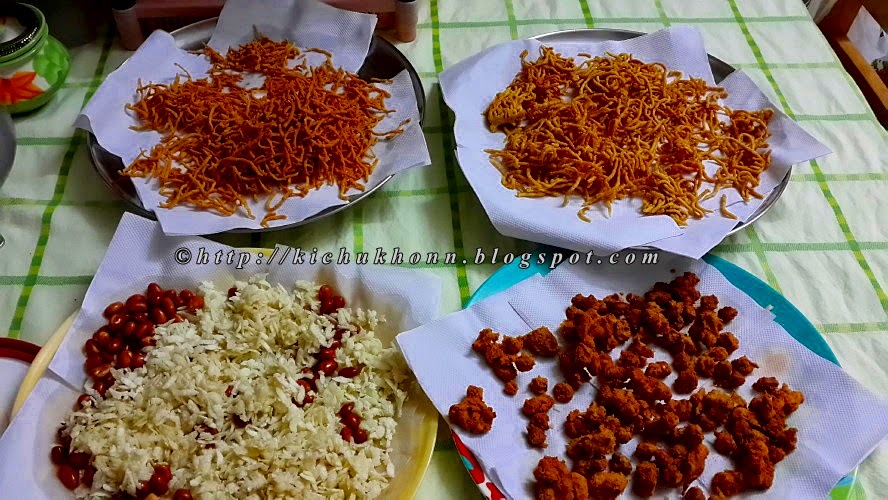
Savouries for Diwali


Diwali at home is a huge thing. Numerous rituals and ever more pujas. Mehendi and and jwellery. Cleaning the house and decorating it. Cooking huge meals and numerous snacks, to be enjoyed by the family as well as offered to guests that pour in. Meeting friends and relatives. Being with family.
Everything.

I am not an expert on traditions and rituals pertaining to Diwali but try earnestly to learn and follow whatever I get to see and be a part of.

Diwali starts with Dhanteras, when new ornaments or kitchen utensils or anything new is purchased. 
The house is cleaned every morning ... early in the morning, before sunrise, and evening.
Fresh Rangolis are drawn both times too. So are the diyas or small, earthern lamps lit.
My mother in law draws wonderful geometric patterns as rangolis and fills them with natural things like atta, turmeric powder and roli .. a red coloured powder.
I did try to make an alpona , the Bengali way of drawing a rangoli but with soaked rice powder and with the help of cotton balls held between the fingers, this time.
But for someone who can't draw to save her life, or anybody elses life for that matter, it was quite a task.
I just drew the feet of Goddess Lakshmi, with some patterns around it and prayed to her to step into my home ... ignoring the  misshapen feet.

Diwali celebration

 Anyway, coming back to Diwali, Rajasthanis worship the kalash or Parendi, in which they store drinking water. The Tulsi and the Amla plants are worshipped too.
 Since the change in seasons starts from Diwali time, i.e. the monsoons taking their leave and winter setting in, the Amla or Gooseberry is a good source of vitamin C and helps build immunity ... thus helping the human body to cope with the change. So is a revered plant. As is the Tulsi, which we all know how good is for us. 
Ghee filled Deepaks are lit and aarti is done for both plants everyday.

On Narak Chaturdashi, we, at home, light diyas to form a huge Om sign. The whole family does this together and is a family tradition.

Diwali morning sees some more, around 3 to 4 different kinds of pujas.
Later in the evening, after the Lakshmi pujan, the lamps are lit and set about all over inside the house and outside too. There shouldn't be a single dark spot anywhere in the house or the garden.

 The day after Diwali is the New year for Rajasthanis and Gujaratis.
On this day Lord Krishna is worshipped with an offering of at least 56 food items ... or the Chappan bhog, and the ritual is called Annakut.
Anna is food  and Kut is hill or mountain.
 So the food offered under the Govardhan hill came to be known as Annakut.

The story goes like this -
Once it had rained continiously for 7 days and 7 nights in Brajdham, Krishna's place of childhood.
To protect the villagers, Krishna had help up the Govardhan hill on his little finger and they took shelter under it. Common lore has it that the during that time, every  villager cooked whatever dish they could and brought it from their own homes and ate together under the hill.
Another story goes that the villagers cooked a huge feast with various kinds of dishes and offered it to Lord Krishna for saving them from the storm and rains.

Whatever the story, Annakut is basically a feast cooked and eaten by families together.
The food is first offered to Lord Krishna, an aarti is done and then the family sits down for lunch. 
The menu is huge ... traditionally. But every house cooks according to its own convinience.
Annakut prasad
The vegetables that are cooked on this day are usually winter vegetables, especially green leafy vegetables, that would be available fresh henceforth, due to the passing by of monsoons and setting in of winter. 
I've heard that my mother in law, once upon a time, would cook more than the actual Chappan (56) bhog. The number of dishes has long declined but she does maintain the tradition of cooking and eating only seasonal vegetables. She even has a beautiful rhyme on this to make it easy to remember what vegetables to eat on which seasons.
I'll try to get it from her the next time we meet.


Signing off today with a photograph of our family Annakut layout last year.

Wishing everyone a very happy and prosperous new year ahead!!


Wednesday, 22 October 2014

Shubh Dhanteras!

Wishing all the readers, followers and visitors of Kichu Khonn a very happy and auspicious Dhanteras and Narak Charurdashi!

While we bring in the new in the form of anything like new jwellery or utensils for ourselves or our families and homes on Dhanteras, Narak Chaturdashi is celebrated by lighting of fourteen lamps and cooking and consuming fourteen varieties of shaak or leafy vegetables by the Bengalis.
This signifies the end of the rainy season ... when you are not supposed to consume leafy vegetables ... and the arrival of fresh vegetables along with winter.

My in-laws celebrate the same on the day just after Diwali and call it Annakut. I'll make a post on it next.

Meanwhile, I tried my best to bring in the Diwali spirit this year, after two whole years of no celebrations.

B went out of his way to get all the fairy lights and deepaks and lamps.
Last night, in spite of having a marathon meetings and presentation, he strung up the lights late in the night so by around 2 am our windows and balcony were filled with glittering and flickering, colourful lights.

I, on my part, did my best to rustle up a few namkeens and sweet dishes.
Was down with a tummy bug, so making any delicacies was a little difficult for me, especially when the wonderful smells wafted around in the house.

I made the Rosh Bora, Poha mixture, my instant Moong dal halwa and some Ajwaini sev.
Since this is a hurried post, I won't go into the recipes.
Will post them soon, hopefully.

Till then, hope you have a beautiful festival time.
May the lights remove all darkness from our lives.


Friday, 17 October 2014

Saantlano Aloo Bhate / Tempered mashed potatoes

Aloo bhate with bori bhaja
Another day has gone by.
And I hardly notice.
It is only late in the evening, when I am finally free, that I realise how fast the day has passed.
And this has been going on for the last close to one month.

After the hectic days of Durga puja, preparations for Diwali have started.
Whatever little I can do, I am doing.
I can't do heavy duty cleaning and cooking like I used to do in the past.
Neither can I whip up huge amounts and varieties of snacks and sweets for Diwali.
Still, I'm trying.

The weather gods aren't helping either.
Most days are cloudy, sometimes it rains too.
Still, I am almost done with most of the cleaning.
Quilts and covers and sheets and linens washed and stored away.
My huge stack of books and curios cleaned and are shining bright.
The kitchen is cleaned and all the bottles labeled. Just the curtain on the kitchen window needs to be changed.
The fridge and the MW shining like new.
Ok, the fridge is new. But still, I did clean it all over again. So ...
Phew!!
kitchen


I am now planning to make some sweets and savoury stuff from tomorrow.
I know it won't be much but B says it is good that I am,at least, being able to  think of making some ...  as compared to my condition last year; so I should be happy.
I however, in my heart, am praying.
And keeping all my fingers and toes crossed.

Earlier, on Diwali, I would make Gulab jamuns, Roshogollas, Moong dal halwa, Mathri, Nimki, Kachoris, Methi ki sabzi, Rassewali Aloo ki sabzi, Dahiwali murmure ki sabzi, Tomato chutney, .... and sometimes some more.
This year I am planning to make do with only a few things ... God willing.

And amidst all this, there is everyday cooking.
After all that gorging during Durga puja, I have turned back to simple comfort food.
Dal, rice, some vegetable fry on the side, a light fish curry ... if I have fish at hand ... on some days.
On other days it is dal, roti and some vegetable dish.

Except for tonight, when I went out of the way and made some Mishti bhaat / Polau for myself.
Also made a spicy Mangshor jhol or Mutton curry ...slightly dryish ... to go with it.

From tomorrow, it will be comfort food in my kitchen ... again.
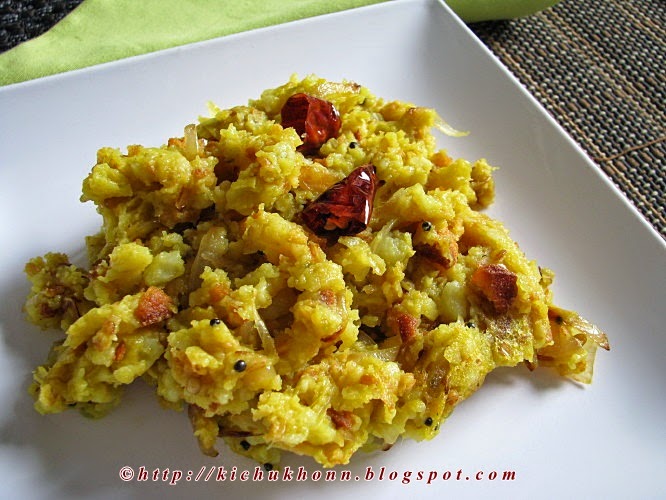
snatlano aloo bhate

The very favourite and familiar Aloo bhate / Bengali way of mashed potatoes is sometimes given a slight change in look and flavour by tempering and frying it a little.
Add some crispy fried and lightly crushed Boris / Vadis to it and it is the perfect accompaniment to a simple meal of dal and rice.

The difference between the two is while the Aloo  bhate is mashed with raw onions, raw mustard oil, salt and fresh green chilles, the tempered version has all of these but lightly fried in mustard oil.
Also, the potato mash is fried too.
And has dry red chillies instead of the fresh green ones.

Need :

Boiled potatoes - 3 big sized ones , peeled and mashed with salt
Onions - 1, medium, sliced lengthwise
Whole dry red chillies - 2 pieces
Haldi / Turmeric powder - ½ tsp 
Mustard seeds - ½ tsp
Salt - to taste
Mustard oil - 1 tbsp
Boris / Vadis ( optional ) - 5 to 6 pieces, lightly fried till brown and crushed 

santlano Aloo bhate
 How to :

Heat the oil in a kadahi.
Add the mustard seeds. When they start to splutter, break the chillies and add.
Then add the sliced onions and fry till well done.
Add the mashed potato and turmeric powder.
Mix well. Adjust salt.
Fey well, mixing everything well.
Lastly, add the crushed badis/boris and mix well.
Remove from heat.
a light meal of dal, rice,kumro bhaja and bhaja aloo bhate
Here is a picture of a light lunch of Mushurir dal, rice, pumpking fry and tempered and fried aloo mash.
Comfort food at its best.
Enjoy!!

best route from pune to shirdi


We made a sudden, impromptu and very quick trip to Shirdi a few days back.
I am giving a small detail here as I realised I had never made a post on any of our Shirdi trips on my Travel blog. 

We left Pune early in the morning at around 7 am, reached Shirdi at around 11 am and went straight to the temple.
Had darshan ... there was no rush as it was a weekday ... and I could spend a quiet 5 to 7 minutes in front of Sai Baba.This time we got some prasad from the temple too, that was being handed out just before the main hall.
Came out of the temple and went for lunch at Shraddha Sarovar Portico, our favourite place of stay whenever we are in Shirdi. Only this time we did not stay.
After lunch and a little rest, we left Shirdi around 3 pm and reached Pune at around 7 pm.
Our marathon trip done!!

In case you are interested, the best route from Pune to Shirdi is - Pune - Ahmednagar - Ghodegaon - Shani Shingnapur - Shirdi. 
The highway is excellent all along. But the stretch from Shani Shingnapur to Shirdi is good only for around 6 to 8 kms. After that it is extermely bad, all the way till Shirdi. That is the only dark spot on the otherwise perfect road condition.
The road is filled with crater sized pot holes and loose gravel.
You need to be extra careful on this stretch, especially when there is heavy traffic ... usually on weekends and holidays.


If I am not able to make another post before Diwali, here is wishing you a very happy Diwali!!
Kichu Khonn and I hope that the festival of lights brings much joy to you and your families!!

Cheerio all!!