Showing posts with label Odiya cuisine. Show all posts

Thursday, 26 August 2021

Light Mutton Stew .... spicy, soupy and protein rich galore


Sunday done right.
 With a mutton curry that is very light with a thin soupy gravy to sip on while the rain dances outside.
Don't go by the plain Jane look of it .... this innocent looking bowlful packs quite a punch.
Fragrant with whole garam masala , spiced with black pepper ,
garlic as well as red chilli powder. 

I love spicy food and this one did clear up my throat later .
It is protein rich  and perfect for immunity boosting.

The recipe is very very easy.

I marinated the mutton  with vinegar and turmeric powder for more than an hour .... I finished cooking the vegetarian meals then .... and then in a heated pressure cooker added ghee ,
whole garam masalas, sliced onions and dry red chilli. 

Fried well till the onions browned well. 


Then added the mutton and fried on high heat for 2 minutes.
Then added ginger garlic paste, a little curd, red chilli powder and fried well till the masalas were well cooked. 

Added hot water and salt and a little sugar.
Rounded off with a sprinkle of my homemade garam masala powder. 

Closed cooker and cooked for 5 whistles on low heat.
And oh .... added potatoes too .

And it is done! Soupy, spicy thin gravy with tender, succulent pieces of mutton that actually melted in the mouth.
Mmmm 😋


 Can you see the mutton actually falling off the bone ?!
It was that soft and tender 😊 

You can pair this with either rice or parathas or rotis. 

Enjoy !! 

Do you like recipes written this way or do you prefer the whole list of ingredients and the detailed process? 
Do let me know in the comments. 


Monday, 28 June 2021

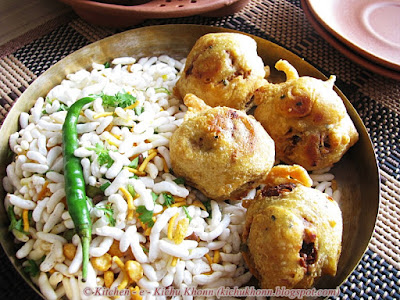
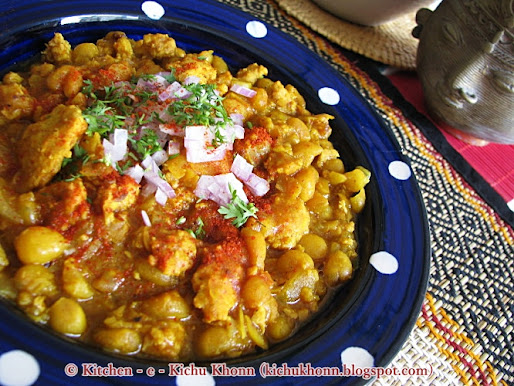
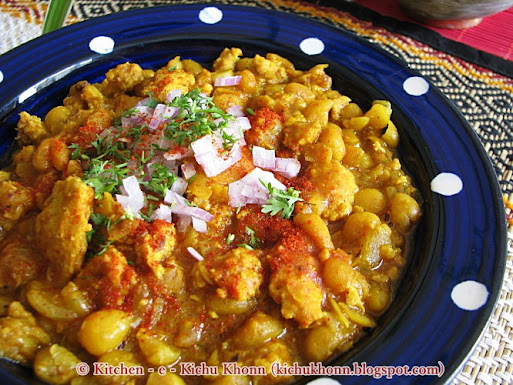
Bara Ghugni / Vada ghugni .... Odisha's much loved street food snack

Growing up, I have never had the chance to eat this beautiful streetfood of Odisha ... the much loved combination of the  Biri bara and Ghughni.  At least not from the streets .... sold on carts with people flocking around it . Passing by, one cannot ignore that aroma of these badas sizzling in the hot oil, the steaming hot ghuguni / ghugni with its typical smell and of course the other aromas of tamarind, lemon and rock salt.

At times it would be made at home but not too often. And anyway it never smelt like the street side ones, so we wouldn't ask for it.

But I did get to taste the real thing whenever we went to my maternal dadu's place in Cuttack. With so many elder cousins , mashis, mamis etc .... every one of them all geared up to nosh through their favourite street foods, it wasn't difficult to mix into the crowd and get a bite of this and a slurp of that, once in a while. 

Now I make such things regularly .... the man has taken to Odia food  like a fish to water. Says that he married into one culture and got another as a bonus 😄

Seeing so many bora ghugni on my feed for the last few days, I decided to indulge in some. And the fact that it has started to rain since morning only made today the perfect day for enjoying this.

I tried to make it like the professionals .... with that hole in the centre ... but gave up after a while and made the plain round ones.

They may look imperfect but tasted yum 😋 

And then, like my Thamma used to say "Pete gele shob somaan " / every food is the same once it is inside the tummy 😄😄

Many started asking for the recipe and when the number of dms became a little too many to type out the whole thing, I decided to make a post here pronto. 
And direct everyone here for the details ..... since it is difficult to write the finer details due to instagram's word limits. 

For the Vadas / Baras / Medu Vadas : 

Soak Urad dal / Biri dali / Biulir dal overnight 
Grind into a paste the next day and keep aside for at least an hour. 

Add salt and beat well with your hands till light and slightly fluffy . 
Add chopped onions, ginger, coconut pieces, green chillies, cumin seeds / jeera and curry leaves to the dal paste. 

Heat enough oil in a deep pan or kadahi. 
Wet hands in a little water, scoop out small balls of the dal paste and let in carefully into the oil. 
Fry them till they are golden brown on all sides. 

Keep on a kitchen towel to drain out excess oil. 


For the Ghugni : 

Soak white matar  overnight. 
Cook it with turmeric powder and salt in a pressure cooker. 

Heat oil in a kadahi ( I use ghee as I am on an oil free diet right now ) . 
Add jeera and broken dry red chillies. 
Add chopped onions and fry a little. 
Now add ginger garlic paste, turmeric powder, red chilli powder and green chilli paste. 
Cook well till masala changes colour and leaves oil on the sides. 
Add the boiled matar and mix well. 
Add enough water and bring to a boil. 
Adjust seasonings and simmer on low heat for at least 15 to 20 minutes. 
Finally, sprinkle roasted jeera powder and remove from heat. 
Let it stand covered for some time before serving. 

You can refer to this post of mine for a simpler, no onion garlic version of the ghugni too. 

To arrange everything : 

Place the vadas on the ghugni in an open bowl. 
Sprinkle roasted jeera powder, roasted chilli powder, chaat masala powder, lemon juice, chopped onions, green chillies, coriander leaves and chopped coconut pieces on them. 


 The Boras / Vadas can be eaten just as they are ..... fresh out of the kadahi and crisp and hot with puffed rice or plain with a cup of spicy ginger tea. 

The ghugni too can be enjoyed by itself with Luchi, Muri / Mudhi / puffed rice. 
Or can be paired with parathas too. 

Enjoy whichever way you want to. 

Here are a few other recipes of Ghugni / Ghuguni / Ghoogni from my blog. 


Stay safe all!! 


Monday, 9 November 2020

Prawn Masala Fry and Prawn Rice ...... cooking a meal under thirty minutes


Yesterday I made a post on my instagram feed on one of my current knitting projects, as I was getting a lot of messages to share my works in progress. 
And I wrote about how this year has been for all of us. 
And could not help contemplating on it the whole day. 
I realised what I had written was just the tip of the iceberg. Given insta's limited word allowance per post, I am not always satisfied with writing there. Which is why I have almost stopped writing a good post. The hurried feel does not suit me. 
I like to write in a way that the reader gets the essence and the feel of not only the photo but also the setting , the prelude as well as the interlude and conclusion. 

So while I did mention how we all found out some hobby to hold on to for comfort in this difficult year, I felt a there is a lot more to it than what meets the eye. 
Like how we learnt to manage our days and to divide time among work and family and chores in a more balanced way.
How we learnt the real meaning of division of labour. 
And how to make the division of chores interesting .... focussing not only on the jobs getting done but also on  how to give the other person a break too. 


And the most important thing we learnt was how to manage the kitchen in the shortest possible time, how to cook up a nutritious meal for the family without getting exhausted and above all, how to come up with quick cooking ideas with the most basics of ingredients. 
And at the same time ensure that it is tasty to please every palate sitting at the dining table. 
No mean feat I must say. 

For me, it has been a long, difficult year when it comes to eating restaurant kind of food. 
Not that we used to eat out regularly. But I had a surgery last year towards the fag end of August and was on monitored food for almost 6 months. And just as we started to eat out a little .... we must have eaten out for exactly three times .... lockdown happened. 
And now it has been 8 months that I have been craving for some good Chinese food. Or a good Vada Pao. And Phuchka too. 

I have made every one of these at home too. And even more like baking breads, pavs, focaccia , cakes .... and so on. But it requires big work. Lots of effort. And at the end I feel so exhausted that actually enjoying the food becomes an effort too. 
So I have turned to cooking some spicy and masaledar food for myself recently. 
Any change to the tastebuds is welcome now. 


Recently, my fishmonger got me some very fresh and good sized prawns. 
They were so fresh that I wanted to keep the sweet taste with just a smattering of spices. 
And so made this beautiful fry. The coating was of spices and the inside held the juicy, sweet meat that was so good when bitten into. 

For the Masala Prwan Fry : 
 
Need : 

Prawns - 6 to 8 pieces, cleaned and deveined 
Ginger garlic paste - 1 tsp 
Jeera powder - 1 tsp 
Red chilli powder - 1 tsp
Turmeric powder - 1 tsp
Lemon juice - 1 tsp 
Rice flour - 2 tbsp 
Salt - to taste 
Oil - to stir fry 

How to : 

Marinate the prawns with the rest of the ingredients except for the oil. 

Keep aside for 15 minutes. 

Heat oil. 

Let in the prawns one by one and fry till done. 

Serve immediately. 


For  the Prawn Rice : 

Need : 

Leftover Rice 
Whole garam masalas 
Chopped green chillies 
Salt to taste 

How to : 

In the same oil that the prawns have been fried, add the garam masalas
and the green chillies. 

Let in the rice and toss well. 

Add salt and adjust the rest of the seasonings. 

Remove and serve hot. 


Enjoy!! 


Here is my link to the post on Instagram where the write up is even better. 
I am going crazy trying to keep track and coordinate my writings at both places. 
Hope to sort out the time management soon so that I can write the same post and thoughts in both places as well as share the links too. 


Thursday, 16 August 2018

Muga dali Pitha / Mug dal er pithe / Moong dal ke mithe cheele

During long vacations in my childhood, we would go over to Dadu's house and spend the days there.
But when there were short holidays, some part of the family would come over to our place.
Some part because fitting in the whole family together was possible only in Dadu's huge house.
We stayed an hour away, on the hills, where Bapi had his factory.
So at times, some cousins  and kakus and kakimas would come over to spend a few days with us.

The house would be filled with voices ... all talking, laughing, calling out to others ... all at the same time while we cousins did what we did best ...  creating our own ruckus and having a great time. 
The kitchen would be busy and while Ma looked into the meals all through the day, it would the kakimas or mashis (aunts) who would choose the job of rustling up their special snacks and sweets for us. It would be one of those times when we kids would to be perpetually hungry and after every hour or so we would walk into the kitchen with a "Khide peyeche" announcement.

While we were indulged on most times, it would be a no show if the time was closer to a meal time like lunch or dinner.
So my Mejo kakima came up with this potent medicine of "Dudh kola muri debo?".
The thought of a bowlful of soggy, puffed rice mashed with banana and milk would successfully douse those whimsical hunger pangs that the aromas from the kitchen had brought about.
And with a hasty "We will wait for lunch / dinner", we would disappear.

I remember one such time when Boro mashi, Ma's eldest sister, was visiting.
Mashi worked as a teacher in govt. schools and had just become Principal and was posted in a school at a nearby district. Since it was summer vacation, she and her daughter were spending a few days with us.

Mashi visiting us meant fun in all ways. She would hold quiz contests, grill us on general knowledge, give us math quizzes to solve, hold competitions complete with prizes ... and so on.
And the best part was getting to eat the food she cooked.
Boro Mashi had magic in her hands.

She could make a light, plain dal seem heavenly.
She could make a plain roti interesting.
She could make the fussiest kid eat up without a peep.
And she was a wizard at making achars.
A dash of this, a handful of that, a little chopping here, a quick beat of hands there ..... watching mashi in the kitchen was mesmerising.
Matronly, with a warm smile on and a solution to any problem always, she was one person I looked up to.
It was on that visit that Mashi had made this Muga dali pitha.
She had sat us kids down with a bunch of questions to solve and had disappeared into the kitchen.
We could hear her chatting with Ma and in a while,  this beautiful, warm, sweet aroma drifted out of the kitchen a spread all over the house .... making its way towards us in the drawing room.
We started getting fidgety but were warned against getting up and going to the kitchen.
Bapi had returned by then and the evening tea was just being served.
And Mashi walked in with a plate full of fragrant, hot pithas.

And what pithas they were!
Crisp on the sides, the sweetness of the jaggery mixed with the fragrance of coconut ... it smelt of something that can be only divine.
They were just fried and out of the pan and still very hot.
We savoured each bite, experiencing different flavours everytime ... the sting of black pepper, the bite of small pieces of coconut, the sweetness of a fennel seed .....

Jaggery and coconut are an integral part of Odia pithas.
And are usually paired with crushed black pepper and fennel seeds.
And the body is usually of dals / lentils or rice powder.
Fried, steamed, roasted ... made in different ways for different occasions.
Yesterday, a few of my friends had come over to visit and brought me a load of cooked food so that I could rest and not have to cook for a couple of days at least.
I was touched but not surprised.
All through the years, every time I have fallen ill .... and god knows when I fall ill it has always been a lengthy affair, sometimes stretching to almost a year .... it has been these friends who have been my rock; my support; my pillars.
I was so happy to see them that I wanted to make something for them that would be quick.

I had boiled moong dal in the fridge for dal tadka .... so decided to make this pitha for them.
I had grated coconut in the freezer too.
So all I had to do was to make a mix and fry them.
My friends joined in too and soon we were all in the kitchen .... chatting, laughing, frying the pithas and eating them right there ... straight off the pan .... breaking each one, blowing on the pieces to cool  and sharing with one another.
We made some ginger tea too and while it rained on outside, I basked in the warmth inside, feeling cozy and loved.

Now for the recipe of the Muga dali pitha or Moog daler pithe -

Need :

Whole green moong dal - 2 tea cups, boiled with a pinch of salt
Gur / Jaggery - according to your taste for sweetness (I used granules )
Maida / APF - 2 tbsp
Rice flour - 2 tbsp
Elaichi / Cardamom seeds - crushed
Black pepper - crushed
Mouri / Fennel seeds - crushed
Grated coconut - 1 tea cup
Water - a little to make the batter
Cooking oil - as you require
Ghee - half of the amount of cooking oil (optional)

There is no perfect measurement for the ingredients ... you will have to decide according to the thickness of the batter, the sweetness you want, whether you want to pan fry or deep fry ... etc. etc.


How to :

Mix everything except the oil and ghee and make a thick batter.

Heat a heavy pan or a tawa.

Add a oil + ghee in equal quantity.

When hot, pour in spoonfuls of the batter to make thick pancakes.

Fry the pithas, first covered and then uncovered, on both sides, till they turn brown.

Serve hot or at room temperature.

Enjoy !!


Sunday, 4 February 2018

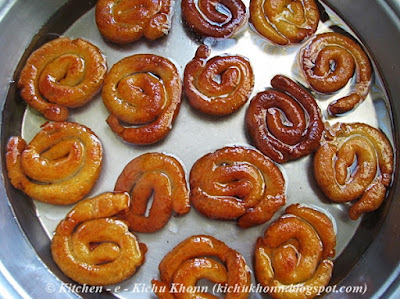
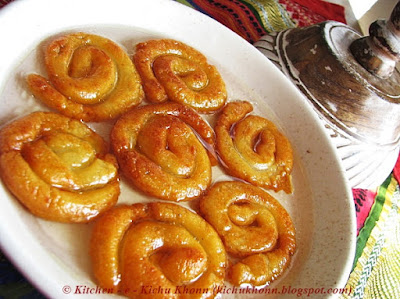
Chanar Jilipi / Chena jilapi / Syrup soaked cottage cheese circles

chanar jilipi

My feet are itching to set off on the road again. My heart is restless and is longing for new visions.
Not goal visions; visual visions.
Like looking out of the window and seeing the countryside fly by. It can be a window of a train or the car ... I don't care much for flights because there is no countryside to look out at, but right now a flight will do very well too.
I just need to get out.

Last year was a whirlwind .... full of travels.
Even before we had emptied our suitcases, we were off again.
So much so that I had no time to update my travel blog, much as I wanted to.
January had started with Hampi and Bangalore, which we did by road and had way too much fun, then Rajasthan just a day after we reached back, which was by train, in
March we were in Mahabaleshwar, by road, Jaipur again in May, by flight,
July in Lonavla and September and October in the US of A, which included Miami, Florida and Disneyland, Orlando too.
Phew!!
I do have a very sincere intention of updating Country Roads with these trips, but not before I wade through the hundreds of photographs and select a few.

The weather, in Pune right now, is fabulous and it would be criminal if not soaked in.
A thought we are taking very seriously.
So we are going out, visiting exhibitions, sales, music programmes and sometimes eating out too.
We have drastically cut down on our eating out ... but do visit our old favourites once in a while.
Where we know the food ... read quality ... is good and the service polite and warm.
Umpteen number of eateries have sprung up in Pune in the past few years but quality is one thing that helps us decide which to try and which not to.
Most places will start of well and then quickly deteriorate in quality .... so we strike it off after two or three visits.
Others will start off weak, but gain momentum and realise the importance of the quality of food.

chanar jilapi

Besides, both of us love home cooked food and very very simple food. If you read my recipes or have tried them out, you will know just how light my cooking is.
And both of us love our food that way.
Give B a dal and rotis and he is the happiest person in the world.
Give me a dal with rice and I am happy.
Give me a light bhaja along with it and I am the happiest girl around.

So when I turned a year older a few days back, B wanted to go out for lunch.
And had been trying select a good place for lunch or dinner.
I, on the other hand, was not being helpful.
Because I did not want to eat out.
A plate of dal, bhaat and begun bhaja was calling out to me in my mind.
I was missing home, my family and the numerous phone calls did not help.
So, when it was late noon, I told B to give up searching.
And set off into the kitchen to cook. That is where I find solace.
So cooked a full meal of dal, roti and sabzi for B and a Chicken curry and Mishti bhaat / Polau for myself.
Indulged myself with a few aloo bhaja too.
There was Tomato Khejurer chaatni in the fridge.

And all these made a happy plateful( here is a shot) for me.

chanar jilipi
And I made Chanar Jilipi.
Or Chenna jalebis. Or Chenna jilapi ( in Odia ).
Or sweets made from fresh cottage cheese.
Call them by any name you want to.
I have been wanting to try my hand at making these for a while now.
And it was such a soul satisfying job .... by the time I finished and stepped out of the kitchen, I was smiling.

These light, soft, delicate, syrup soaked roundels of sweetness are pretty easy to make.
All you need to do is handle them with care.


Need :

Milk - 1 litre
Juice of lemon - 2 tbsp (or more if you need )
Fine semolina / sooji - 1 tbsp
Maida / APF - 1 tbsp ( a little more if you feel the jilipis break when forming )
Sugar - 1 coffee cupful
Water - 3 coffee cupfuls
Green cardamom - 3, crushed and powdered
Cooking oil - 5 tbsp
Ghee - 2 tbsp

chanar jilipi
 How to :

Boil milk.

Add the lemon juice to curdle and make the chana / chenna / cottage cheese.

Strain well. Keep it in the strainer or hang it in a muslin cloth to drain the water well.
But don't make it too dry. It should have some water left in it.

Heat the water and sugar in a heavy pan till sugar dissolves and the water comes to a boil.

After an hour, knead the chana with the semolina and maida till very soft and light.

Add the powdered cardamom and mix well.

Take small balls out of the kneaded chana and roll on a flat plate to make a thick, longish shape.
You can use a little ghee in your hands and on the plate so that the balls do not stick.

Gently twist the long shape into a circle.

Heat the oil + ghee in a heavy, flat bottomed pan.

When hot, gently let in the chana circles into it.

Fry one side till brown and then gently turn it over.

Remove carefully and let into the sugar syrup.

Soak well for a good two or three hours before serving.

 chanar jilipi

Wish you all a very happy spring!
Go out, enjoy the sun, the breeze, the flowers and be alive!!

Enjoy !!!


Sunday, 21 January 2018

Kachkolar chop / Batter fried raw banana

 Kachkolar chop

 And winter is gone! 
Just like that. One fine morning I wake up very early and do not feel like snuggling back into my soft, light yet very very warm razai, which are always a part of my shopping expeditions in Jaipur, any more. Instead I want to step out into the balcony to get some fresh air.
Which I do.
And was struck at the change in the air .... it was no longer chilly. Just a light cool.
And then, as the day progressed, I could feel the sun turning hotter and hotter.

It was just a day after Makar Sankaranti. Technically, it should still be very cold.
Instead, the days are turning more warm.
In fact the afternoons are so hot that all I want is some cooling Paanto bhaat for lunch.
I frantically went ahead and made some Mushur dal er bori as I was already out of stock and did not get any time to make them this winter.
Can't imagine a full year go by without a little bori on my plate.

And a couple of achars too.
I get the full sun all day through my big bay windows ... but only in the winter ... when the sun shifts south. Once it is Uttarayan, the sun quickly moves up north and I won't get any direct sunlight any more.
Boris need the soft warmth of the winter sun to dry slowly.
Hence my hurry.
Today I have soaked some Urad dal to make some spicy boris.
After this batch, am all set for the summer and the upcoming monsoons with enough bori in my pantry.

You can check out my recipes using the bori / vadi here. 

Kachkolar chop
 But this post is not about the bori.

Inspite of falling and staying ill for the larger part of winter this year, I did manage to rustle up some quick snacks .... more for myself to revive my bland taste buds than for anybody else.
A few I managed to click ...
among which was the Kaachkolar chop that I made one day.
The ones that were made in the evening did not see the light of the day.

I had boiled and stored some raw bananas .... I do that when I get them in bulk and to stop them from ripening and turning soft ... along with some boiled potatoes.
So one day, when I had skipped lunch and was very hungry by late afternoon, I made some spicy chops to perk me up.

While usual Bengali chops are usually coated with bread crumbs and then deep fried, I often coat them with besan/gram flour batter... thanks to my growing up in Odisha.
The chops there, like the Aloo chop or the Mutton chop are always coated with a thick batter of besan. I love the crisp outside and the soft, spongy inside of the coating before reaching the spicy filling inside.

Kachkolar chop

Here is how you go about it.
If you have the raw banana and the potatoes already boiled and stored, it will be a breeze and won't take much time at all.

Need :

Raw banana - 2, boiled and peeled
Potato - 1, boiled and peeled
Onion - 1, chopped
Green chillies - 2, chopped
Ginger - chopped, 1 tsp
Roasted jeera/cumin powder - 1 tsp
Red chilli powder - 1 tsp
Amchur powder - ½ tsp
Coriander leaves - chopped
Salt - to taste
Sugar - a pinch
Oil - to deep fry

For the batter -

Besan / Gram flour - 6 tbsp
Cooking soda powder - a pinch
Salt - to taste
Water - to make a batter 


How to :

Add a little water at a time to the besan + soda + salt to make a very thick batter.

Mash the raw banana and the potatoes with everything except the oil.

Make small balls and roll them smooth.

Heat oil.

Take the balls, dip into the batter and carefully let in to the oil.

Let it fry on low heat till it turns golden brown.

Remove and place on paper napkins to drain excess oil.

Kachkolar chop
Serve with your favourite dip or ketchup.

I paired them with some crisp muri / puffed rice tossed with a dash of mustard oil and some spicy chanachur.
And of course, there was ada chaa / ginger tea on the side.

And as I sat in the warmth of the late afternoon sun that winter day, munching on the muri, with a bite of the hot chop, memories of winters back home came flooding back.
And I gave in.
Let them wash over me as I regaled B with all those stories from my childhood winters spent with my cousins in Dadu's huge home and even huger chaad / roof terrace.
Of hot evening snacks being made in the kitchen for the uncles who would soon return from office.
Of Thamma calling out to a house help to hurry.
Of us squealing, screaming, laughing as we run all about the house, from the roof to the uthon in no time.
Of Dadu's indulgent smile as he watched us kids rushing pell mell all over. 
Of the wonderful smells wafting all over the dining room.
Of a kakima calling out to us to wear our sweater and scarves before evening set in.
Of the sun turning huge and red before dipping behind the eucalyptus trees.
Of one of the happiest childhoods one can have.

Kachkolar chop

Enjoy!!


Saturday, 22 July 2017

Macha Munda Chencheda / Fish head cooked with spices

maacha munda chencheda
 Too many people all around. Too much of noise. Too many talking together. Too much of laughter. Too much of cooking going on.
Complaints throng my head. I look around for a little solitude. And do not find any.
Voices float all around me ... someone calling out, someone laughing out, children shrieking as they play, family greeting the just arrived ones with much embracing, smiles, laughter and jokes.
House helps hurrying all around, trying to keep pace with the orders given.
There is an air of festivity all around.

I look on from the terrace on the third floor of our house. And finally turn away in disgust.
I am angry.
I do not understand this casual air around. This air of happiness spilling forth amongst people who have come to our house. I do not understand this feel of vacation among them.
I am so angry that I spend all my time in the little room on the terrace.

Ma, on the other hand is more welcoming. She is all around ... giving orders, looking into the guests' comfort, assigning rooms, everything.
I do not help. I do not want to be a part of any of this.
Given a choice, I would happily be back in my home miles away; would give anything to avoid this time here every year henceforth.

macha munda chencheda
I know I am being unreasonable. I know everyone is trying to lighten the air, ignoring the real, morbid reason why they are here. But I can't help it.
I miss Bapi.
I look around and miss him all the more.
Bapi loved having people over ... be it relatives or friends or unkown guests.
When relatives dropped in for a day, he would arrange for the kitchen to be filled with all kinds of fish and meat and vegetables. He remembered each one's favourite and made sure it was there on the plate.
A variety of mangoes during summer, Ilish from Kolaghat during the rains, the best mutton and prawns, ... you just have to name it. And it is there.
He did not talk much himself but loved to have people, especially our huge family, around him.
Our house in the little hilly town, where Bapi, Ma and I stayed because of the proximity to Bapi's industry/factory, came alive, resonated with laughter and loud, boisterous talking whenever the family and Dadu and Thamma dropped down to visit or spend a day.

And now, when everybody is here, I look around but can't find Bapi. And feel angry all the more. 
I just want some quiet around me.
And my Bapi.
And his voice, calling out to me.

macha munda chencheda
Back in Pune, I often cook Bapi's favourite dishes, pretending he has asked me to. And this fish head curry is one of them.
In Bengali, it is called the Macher matha diye chanchra, and usually has vegetables added to it.
Even the Odia version has vegetables most of the time. But this one is different.
This one is a replica of the chencheda from a restaurant ... one that Bapi took solace in when it was a pure veg day at home.
Since Bapi could never eat a pure vegetarian meal, and had to have a little fish on his plate, he would arrange for some of this chencheda to be delivered home and had his lunch with this on the side. I too loved this chencheda , but it was way too spicy for me then.

All I remember is the overwhelming flavour of garlic and the reddish oil floating.
There would be very small bits of potatoes, almost invisible.
But the flavours of the fish head and garlic would be intact. At times, I could see a small piece of the tej pata,  a little green cardamom and some  cinnamon at other times.

It has been so long since I tasted it last that I do not remember almost anything about it.
Except that it tasted heaven;y.
And Bapi loved it.
With the dominance of garlic, so common in Odiya food, this fish head chencheda stays on as one of my favourite dishes.

Need :

1 Rohu Fish head - fried and broken into pieces
Onions - 2, chopped
Garlic paste - 4 tsp
Ginger paste - 2 tsp
Tomato paste - 3 tbsp
Green cardamom - 1, crushed
Cinnamon - 2 small pieces, crushed
Tej pata / bay leaf - 2
Haldi powder - 1 tsp
Red chilli powder - 2 tsp
Dhaniya powder - 2 tsp
Potato - 1, chopped into very small pieces
Garam masala powder - 1 tsp
Roasted jeera powder - 1 tsp
Mustard oil - 5 tbsp
Salt - to taste

How to :

Heat the oil in a heavy kadahi / wok.

Add the crushed garam masala and the tej pata.

Add the onions and fry till they turn pink.

Now add the ginger + garlic paste and the tomato paste.
Fry well.

Add the haldi + mirchi + dhaniya powder and mix well.
Fry on low heat till oil starts to leave the sides.

Add the potato pieces, salt and a little water.

Cover and cook till the potatoes are done.

Remove cover and add the fried fish head.
Mix well.
Add some more water for everything to come together.
Cover and simmer till it dries up.

Add the garam masala powder and the roasted jeera powder, give a good stir, cover and remove from heat.

macha munda chencheda

 Serve hot with rice.


Thursday, 15 June 2017

Dahibara Aloodom - Cuttack's favourite and much loved street food

Dahi bara aloo dom
 Right now, at this moment, the state of Odisha is celebrating the monsoons with a festival that is very unique to it.
It is celebrating Raja, the festival of Mother Earth turning fertile and ready for the sowing season.
Primarily an agricultural state, Odisha has this festival celebrated with much enthusiasm at homes where every unmarried girl and married woman is celebrated during this festival.
It is believed that Mother Earth goes through the ritual of menstruation during this time and hence Raja is celebrated as a festival of fertility. There is a festive air all over and the four days of the Raja festival sees a lot of home cooked delicacies too.

The festival of Rajo ( pronounced as Rawjaw ), starts with one day before the actual festival. That day is called Sajabaja ... or decking up with new clothes, flowers, etc. or preparing for decking up by getting together new clothes and ornaments.
All agricultural work is stopped from the first day of Rajaw or Pahili rajaw till the fourth day.
Women dress up, cook, eat and share numerous delicacies like Podo pitha and other kinds of pitha, rich curries of mutton and chicken, and all kinds of sweets and payesh too.
Swings are a must ... every home and backyard will have a swing set up, either on the branch of a strong tree ... usually the mango or jamun or a neem ... and girls swing on it for fun.
This resembles the Teej festival of Rajasthan, that celebrates monsoon too.

Dahibara aloodom
 While my heart yearns for those beautiful days of summer vacation spent at my maternal Dadu's house in Cuttack, I set to create as many Odiya dishes as possible in my kitchen ... in celebration of those days and their memories.
Since my mother and her siblings were a big lot in number, the huge house would fall short when it came to accomodating all of them when they visited with their families.
So many would spill over to Boro Masi's place .
But would get together as soon as the day started and we kids, more than 15 in numbers, would spend the days with numerous adventures and mishaps, that would later stay on in the family as anecdotes to be recalled during get togethers.

I remember choto Mama would set up a swing for us in one of the branches of the huge ... and when I say huge it means HUGE ... Neem trees on the bank of our pond.
The pond had a cemented border and steps on four sides, complete with cement chairs for people to sit on and enjoy the cool breeze in the summer evenings when there would be no electricity power.
It was surrounded with other strong trees like the mango and the jamun too, but this particular neem stood a little behind the steps of the pond .... which gave the elders the assurance that no child will drop into the water, while swinging.

The swing itself was a broad, wooden plank with four holes drilled into it at the corners.
Thick jute ropes would then be knotted into them and tied in the most unique way ... nobody could undo them ... they were so secure.
And the swing would be set up in the highest possible, strongest branch ... which means it was a long swing. When we gained momentum and swing way high up, we would be directly above the waters of the pond. While I have never tried it, my elder cousin brothers have often jumped from that high right into the water, with a huge splash ... that would send us young ones shrieking into the water too ... but from the steps.
Dadu had made sure there was a gradual slope and the it was cemented too, from the banks, so that the littlest of grandchild could step into the waters and enjoy.

dahibara aloodum
 The other beautiful memory that comes back to me from during those vacations is the gorging on street food. By the elder cousins to be precise .... we kids would merely be around but share the excitement, nonetheless.
Street food was a no no, as usual. But the older ones got to bribe the househelps to get us some anyway.
Secret messages would be passed along, avoiding the nosy elders, and we would all get together on the terrace of the third floor of the house .... where most elders avoided going due to the arduous climb ... and get one of the house helps to get us the forbidden street snacks.

One day it would be the singara + aloo chop, the Ghugni on the other. Or the much loved phuchka / gup chup ( as it called in Odiya) on other days.
But it was that one thing that everyone kept their ears perked up for .... that long tone of the man on the cycle, slowly pedaling through the quiet, lonely neighbourhoods on hot summer afternoons, two huge handis of aluminium hanging on both sides of his cycle, calling out "Alooooooo dummm dahi baraaaaa!".
And then two long rings of his cycle bell.

N didi would be up in a flash .... tip toe out of the room, and jostle and bully any one of the house helps to wake up and send the sleepy eyed fellow to buy the lip smacking Aloo dum dahi bara.
The man would make a small bowl by folding a fresh, green shaal leaf, quickly throw in some aloo dum and some break a bara / vada from the dahi vada, add some chopped onions and green chillies. a handful of spicy mixture, some more dahi and some spicy powdered masalas. A final dash of red chillies and rock salt and he hands over the leaf.
Sometimes he would add the ghugni to it too ... but not always.

By the time it would reach us, the leaf would be leaking and the precious droplets of the spicy water would be disappearing fast (which is why we sent the boy with small boxes much later ... helped by our Didima/grandmother). We would all jump in and try to get at least a couple of spoons each.
It was heaven.
And stuff that childhood memories are made of. 😃

I made a plate for myself when I had made the Aloo dom.
And sent a thought to dear N didi , who is no longer around to enjoy these sinful things that she so loved.

To make this plate of Dahi bara Aloo dom, you will have to make the Dahi bara first.
Preferably a day before.

Then you make the Aloo domm.

Then you will have to chop up some onions + green chillies + fresh coriander leaves.
Then take a plate, arrange the aloo dom and the vadas from the dahi vada.

Now add a good amount of the sour and lip smacking dahi all over it.

Then add the chopped onions + green chillies + coriander leaves.

Then add a good dose of rock salt + red chilli powder + amchur powder / lemon juice.

Now add a final spoon of the dahi and throw in some spicy mixture.

Dahibara aloodom


Perfect for a monsoon day or evening.
Since it is so filling, I usually have it for lunch or dinner .... especially with friends and family.
Yep ... you have to have company to enjoy this .... those close to you, those who will sniffle with you when the spice is a tad too much and those who will laugh with you thinking of long gone days.


Enjoy!!


Monday, 12 June 2017

Aloo Potol er bhaja / Stir fried potatoes and pointed gourd

Aloo potol bhaja
 I have often noticed on social media that every time the Bhaja is mentioned, it attracts a lot of shocked 'whoah!'s or a very predictable reaction to the 'oil' used to make it.
At first, I used to wonder why.
I mean, what has the bhaja to do with a lot of oil, quite did not make sense to me then.
And then I slowly realised that most of the people who reacted this way are non Bengalis and the actual meaning of the 'Bhaja' is lost in translation.

It made me think of what Devdutt Pattanaik had said in one of his programs on the tv ... how the intricate details of our culture and ancient writings could not be explained or named by the English with their limited words .... hence they categorised everything under one word - 'mythology'.
The same way, non Bengalis have no idea of the word 'Chanka' and categorise eveything under the name 'fry' ... the straight literal translation of the bhaja.

Except for the brinjal / Begun / aubergine, every other vegetable that is called a bhaja or fry is stir fried.
And that is possible with a very limited amount of oil too.
And nowadays, it can be almost oil free too ... thanks to non stick cookware.
I, however, do not use non stick cookware at all and stick to the good iron kadahis ... which are excellent to stir fry in, with very little oil, once they are seasoned well.

The brinjal / Begun is deep fried because it has a tendency to soak up oil. So when deep fried, it can be drained well and does not hold back the oil.
Similarly, the Luchi, every Bengali's favourite, is deep fried, while the Porota is not.
So we say "Luchi chanka hocche " and "Porota bhaja hocche".

And every Bengali will have at least two or three vegetables bhaja on their plate for lunch or dinner. Or for the jolkhabar / breakfast or along with in-between meals too.
And no, they are not soaked with oil and neither are they unhealthy too.

Aloo potol bhaja
So go ahead and enjoy that bhaja. They are a great way to get some veggies into you.
Are quick to make and the lightest of way to enjoy vegetables.

I have the Aloo Potol bhaja for you today.
I have got some very good Potol / Parwal / Pointed gourd this summer.
While I am usually happy with the Potol bhaja / Potolo pithau bhaja  (this one is my favourite ) along with some dal and rice, I did make some Chenchki, aloo diye bhaja and also a Potoler Rosa / curry with gravy.
And yes, the Potol posto too.
I did not make the Potoler chop this time but if you want to try it, the recipe is here.
Also it has the recipe of the Aam Kasundi that I had made for the very first time.

I had clicked these snaps so thought of making a quick post on this.
And also share a good news - just saw this morning that Kitchen-e-Kichu Khonn has been listed among the top 100 food blogs on the planet by Feedspot.
And I get a badge too , to display on the blog! 😊
You can check it out on the right column.

So could not wait to hurry over and thank all of you for your love and encouragement and comments and interactions ... all of which give me that push to keep blogging and posting.
Makes all the efforts of cooking, clicking, cleaning up, making the time to sit down and write to you here .... very very worthwhile.
I am so glad to be able to share this blog and little parts of my life with you !!


Now, to make the simple Aloo Potol er bhaja.

Need :


Aloo / Potatoes - 2 medium sized, cut into medium thick slices
Potol / Parwal / Pointed gourd - 5 medium sized, cut into slices
Onion - 1 big, cut into thick slices
Mustard oil / any oil - 1 tbsp
Haldi / Turmeric powder - 1 tsp
Red chilli powder - 1 tsp or less
Salt - to taste


How to :

Heat a kadahi well.

Add the oil and spread it all over.

Add the onions and stir fry on low heat till they turn pink.

Now add the potatoes, the pointed gourd , haldi powder, red chilli powder and salt.


Cover and cook till the vegetables are done.
Do remember to check and stir them once in a while.

Remove cover and fry them in the open till the potatoes turn slightly brown.

Remove and serve hot.

Aloo potoler bhaja
This bhaja goes very well on the side with dal and rice or when paired with rotis or parathas.

Enjoy!!


Wednesday, 7 June 2017

Aloo Dom .... cooked the typical Odiya way, with loads of flavour and spice and perfect for a snack

Odiya aloo dom
Aloo dum, Dum alu, Alur dum .... different names for different kinds.
The only common factor is the aloo / potato. Otherwise, there is absolutely no similarity in any of them. 

I had been craving Odisha's Aloo dom for a long while. These days, it is almost next to impossible to get hold of it .... not even on my visits home.
And no matter how much ever I tried, I just could not get it right .... whenever I have tried to make it by myself.
It always lacked that special flavour; that something that goes 'zing!' inside your head and your heart sings either 'yes!!' or 'home!'.
I have never eaten it at home ... our cook never made it.
I had tasted it only at my Odiya friends' houses or eaten it as a chaat / street food.
So,whenever I thought of it, I would get that twist in my heart ... almost leading me to sadness.
And yes, I had often wallowed in the self induced morbidity that I might die before I got to taste my favourite Odiya Aloo dom, ever again.

Cuttack aloo dom
 But somebody up there yonder pulled some strings, I believe. And I got to make this authentic way of the Odiya Aloo dom; finally.
This wonderful lady from a group answered my question for the authentic Odiya Aloo dom, mentioning that it has been Aloo tarkari / curry all the while and has no idea when it started to be called the Aloo dom.
I got some baby potatoes the very next day and made this Aloo dom, which is often served as a street food in Odisha ... served with a dash of this and that spice, chopped onions and other condiments. Quickly tossed and plated out in a small bowl made of a leaf of a local tree ... the shaal tree. 
This is eaten with luchis, parathas or puris too, and usually for breakfast or dinner.

I had in mind to pair it with something else too ... post coming up soon.


Aloo dom
 I leave you with this today.
Will be quiet for a while now.
Too depressed with the rampant plagiarism all over ... especially idea plagiarism.
Makes me want to stop blogging or sharing recipes or tips altogether.

Updated :

Ok ... here is the recipe ...

Heat mustard oil ... add chopped onions and fry till translucent.

Add bay leaf + jeera and + dhania powder  + turmeric + salt + red chili powder + ginger garlic paste.

Add blanched tomatoes or freshly cut tomatoes ..fry the masala till oil oozes out.

  Add boiled and cut potatoes + water , cover and cook.

Add garam masala and simmer for a couple of minutes.

Aloo dom

Enjoy, folks!!!


Tuesday, 23 May 2017

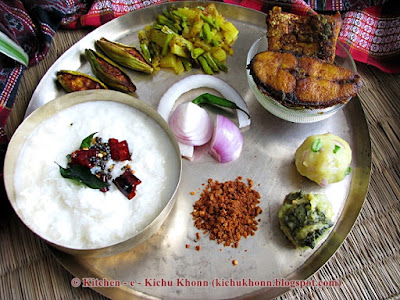
Pakhala or Paanta bhaat or Fermented rice and water ... going back to traditional staples and completeing 9 years of food blogging


Paanta bhaat
 Yes, 9 whole years.
Albeit with a few breaks.
But 9 years, still.
And this is what I wrote on my wall on facebook -
"Food blogging is just as much hard work as it is fun.
Cooking whole meals for just one post to rearranging an already set table for just one photo.
Rushing to keep up with the sun for some natural light to waiting with bated breath for the reactions to your food, photos and recipe.
Asking hungry family and friends to hold that spoon as you catch a click.
Ignoring illnesses and bad days to complete that pending post. Or to reply to a reader's query on mail.
Sitting up nights after a full day's chores to complete writing down the lines that have been playing in your mind the whole day.
Getting to know wonderful people who are now more than just blogger friends ... they are real friends now.
Thanking you all, as I complete 9 years of food blogging, for being a part of my journey with Kichu Khonn.
Love you all! "


Yes, this roller coaster of a journey would not have been possible without all of you and your support and love.
So, a sincere "Thank you!" from the bottom of my heart.

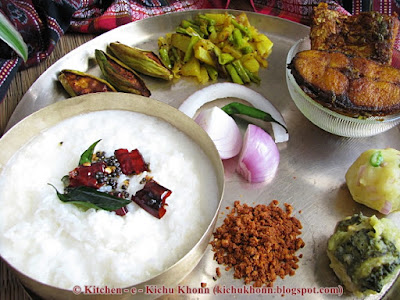
I have with me today the photo of our very tradional Paanta bhaat or the Pakhala, as it is known in Odisha. I had posted this photo as a part of the Pakhala theme in one of the most traditional food oriented groups on facebook.
And had recieved an overwhelming response.
After which I shared it on my page for this blog on facebook too.
And was so happy to see that many still prefer our traditional and old ways of food and eating.
Many came out to say that while they absolutely love this, sadly, the paanto bhaat is slowly losing its popularity.
( You can read as well as write in your views on the Paanta bhaat too, here. )

Not so in Odisha ... that much I can say with conviction.
While the Paanta bhaat or the Pakhalo is a very regular and common meal in rural Bengal and Odisha, come summer and its popularity doubles in many households, including urban ones.
Traditionally, it is rice and water, left overnight (or more) to ferment slightly, and is eaten with a number of side dishes that depend upon the socio economic conditions.

Once upon a time, doctors used to advice rural people to just eat panta bhaat with a little saag / leafy vegetable ... that is enough to fulfill the vitamin, especially B12, as well as required carb for a person.
While people in rural Bengal and Odisha eat it with saag, a little fish, potatoes, onions or whatever vegetables are available, people in cities have glamorised it with a side of dishes made with posto and sometimes the very rare Ilish maach bhaja too.
Extremely cooling, the much loved panto bhaat is now a part of many restaurants too.


Pakhala
 
The perfect pairing to the pakhala will be all kinds of bhajas ( of both vegetables as well as fish ) and makhas or bhartas.

Here is my layout for today -
Baasi paanto with doi / basi pakhala (fermented), bori bhaja / badi chura , ucche sheddho / kalara bhaja, aloo sheddho makha / aloo chakata, rui maach bhaja, aloo borboti bhaja, potol bhaja, narkel nadia, peyaj, kancha lonka.


Paanta bhaat
I will try to make some more posts on the Paanta bhaat or the pakhala, before summer runs out.
Till then, thank you again folks, for all the love!

Enjoy life!
Have fun!!
And here's to good food!!!
Cheers!!


Tuesday, 11 April 2017

Mangshor Ghugni

Mangshor ghugni
With Poila Boishakh just around the corner, I thought I will give my light, vegetarian recipes a skip and post this Mangshor Ghughni.
The photos have been in my drafts for quite some time now ... and I really have no reason why I did not post this still.
What with summer bearing down heavily on us much before the expected time, I seriously doubt any Bengali will cook up a rich, heavy feast to celebrate this first day of the Bengali new year.
But having said that, I know there will be feasts.
And then there is always Unienzyme.

I do not have any intention of eating out in this weather and have decided to stick at home and cook something light and traditional.
For old friends coming by.

This year, my menu for the Bengali New year or Poila Boishakh will be from my blog. Everything that I plan to cook is here on Kitchen-e-Kichu Khonn.

Like this Mishti Polau, this very light Narkel chicken, some bhajas or vegetable fries, a Doi Maach or a kalia with the Rui / Rohu fish, and Aamer chaatni.
For the vegetarians, I will prepare some Koraishutir kochuri ( I have already made and frozen the pur / stuffing ) and this delightful Saunf paneer.
Planning to get some mishti doi from our Bengali shop, if possible.

I am hoping this will be enough.

https://www.google.co.in/?gws_rd=ssl#q=mangshor+ghugni+kichu+khonn
I had made this Mangshor ghugni sometime back when I had some guests over.
Actually, all I had to do was to put together the already prepared and frozen Chicken keema with a freshly cooked ghugni.
That's all.

I had kept some chopped onions, green chillies , saunth / tamarind chutney and some homemade Aam kasundi on the side for the vegetarians. They loved sprinkling the condiments themselves and playing with the level of spices in different helpings.

For the minced chicken :

Cook the chicken kheema this way.
For the ghugni :

Need :

Dry white peas - 1 cup, soaked over night
Jeera / Cumin seeds - 1 tsp
Whole red chillies - 2, broken
Onion - 1 medium, chopped
Ginger + garlic paste - 1 tbsp, home made
Haldi / Turmeric powder - 1 tsp
Red chilli powder - 1 tbsp
Roasted jeera powder - 1 tbsp
Garam masala powder - 1 tsp
Sugar - to taste
Salt - to taste
Cooking oil - 2 tbsp ( I use mustard oil )

How to :

Boil the matar or the dry peas the way I have done for this recipe.
They should be cooked yet stay almost whole.
Not soft and mushy like I make for the simple, light Ghugni or the Ragda pattice.


In a kadahi / wok, heat mustard oil.
Add jeera + dry red chillies + chopped onions.
Fry till the onions turn reddish.

Add the ginger + garlic paste.
( Remember the chicken kheema will have ginger garlic too. So go easy on this. )
Fry well.

Add turmeric powder + red chilli powder +  sugar.
Fry well till the masala starts to dry up and the raw smell is gone.


Now add the boiled matar / white peas + water and mix well on high heat.
Adjust water + salt.

Cover and simmer for around 5 minutes on low heat.

Remove cover and add the chicken keema and mix well.
Check for salt.

Adjust water, cover and simmer for another 10 minutes till the flavours mix well.

Remove cover, sprinkle red chilli powder, roasted jeera powder + garam masala powder.
Give a mix.

Cover , raise heat, give a boil, switch off heat and let it stand covered for 5 minutes.

Serve hot.
https://www.google.co.in/?gws_rd=ssl#q=mangshor+ghugni+kichu+khonn

This goes very well with paratha or luchi.

Enjoy!!


Tuesday, 13 December 2016

Moong dal cooked with fresh, seasonal vegetables

( Vegans just skip the ghee )


"Tumi ki ekhono eka bikele, anmoney, amake bhabo ..."

It is almost quarter past one in the night and that is Rupankar singing on shuffle mode into my ears.
There is a quiet all over ... the winter night has settled inside different coloured blankets; snug and warm.
The sky is unusually bright and the stars twinkle brighter than ever.
As I glance out into the night, I see a white layer of smoke on the trees. It is not fog.
Someone, maybe some of the night security guards of the buildings,  must have lit a fire on the streets, to stay warm.

"Akash e shona rong ..."
The song has a summery feel to it.
Reminds me of long gone summer evenings spent at home. I used to love staying up at night, either knitting or embroidering. And almost always, it would be Jagjit Singh crooning away.
Irony .... especially when it is the middle of winter right now.
That is the magic of music I guess ... can easily take you to back to summer evenings filled with balmy, heady breeze or to dark, rainy nights of thunder and storm, when it is actually cold and chilly outside.

Now, I have grown up and ventured into other aspects of music too. Like Bengali music is no longer limited to Rabindra sangeet for me. Or Bengali modern songs do not mean only those albums released during Durga puja.
I do listen to a plethora of other singers and their experiments with different genres.
And have learnt to love all of them.
That is how we grow up I guess. Learn to be patient. Learn to like and love.

Like, I like this very simple vegetarian dish made with just a few vegetables and some lentils.
Fresh, healthy and light on the stomach.

This is actually a cross between the very common Dalma and Moong dal with vegetables.
And it entirely depends on what masalas I have at hand .... as in dry masala powders.
I mostly use just the roasted jeera/cumin powder with a dollop of ghee to dress this. You can go ahead and use garam masala too ... but that might take away the fresh flavours of the roasted dal and the vegetables .... let me warn you.

I also add grated coconut to this for both nutrition as well as the flavour factor.
The fresh coconut adds a sweetness to this ... so no added sugar needed to balance the salt.
I almost never use tomatoes in my cooking ... very rarely if I do ... mainly because I do not like the hybrid fleshy ones that impart no taste at all.

Winter with its bounty of fresh vegetables is the perfect time to make this dal with vegetables.
Full of fibre and nutrition, it is great as a breakfast if paired with Soru Chakli pithe, as a lunch if paired with rice and some papad and achar, and dinner if paired with rotis or parathas.
Not to mention that it takes just a few moments to cook.


Need :

Yellow moong dal - 1 cup
Fresh vegetables - cut into cubes
I used potatoes + cauliflowers + drumsticks + okra + beans
Grated coconut -  ½ cup
Jeera / Cumin seeds - 1 tsp
Whole dry red chillies - 2, broken
Grated ginger - 1 tsp
Roasted jeera/cumin powder - 1 tbsp
Red chilli powder - 1 tsp
Haldi / Turmeric powder - 1 tsp
Ghee - 1 tsp
Salt - to taste
Water - to cook ... around 4 cups
Cooking oil - 1 tbsp , I use mustard oil
Fresh coriander leaves - chopped. for garnish

How to :

In a heavy bottomed pan or kadahi, dry roast the moong dal till it turns aromatic and very slightly brown.
Remove from heat, cool and wash well.

Heat a pressure cooker.

Add the oil.
When smoking hot, lower heat and add the jeera + dry red chillies.

Add the ginger  + the vegetables and stir well.

Add the haldi + red chilli powder + salt + the dal.

Stir and fry well on low heat.

Add the coconut and enough water to cover everything .

Cover and cook for two whistles on low heat.

Remove from heat and cool.
Remove cover and check for consistency. If needed add some more water and bring to a boil.

Check for seasoning and add the ghee.
Cover and let it simmer for a few minutes.

Serve hot with a sprinkle of  roasted jeera powder and fresh coriander leaves.


Enjoy!!

PS: I am trying my best to compile and write about my trip to the USA in my travel blog, Country Roads,  as regularly as I can. 
I am almost always logged in there ... but it is a huge task shifting through all those photos and going back in memory ... especially when I am down with the sniffles and a sore throat and all the accessories that come along with them, right now.
They have kept me bed bound; but I will be posting my third post very soon.
Till then, do bear with me my friends.