Showing posts with label authentic. Show all posts

Friday, 13 April 2018

Plastic Chatni / Chutney made with Raw Papaya .... a Bengali favorite

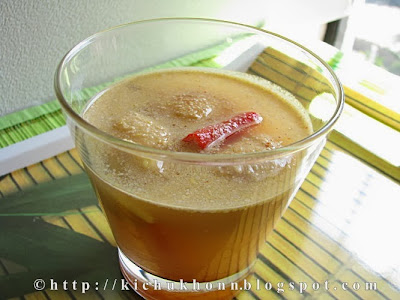
plastic chatni
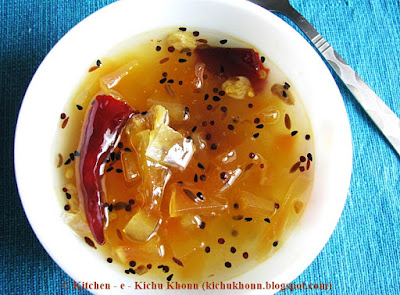
 Thin, transparent slices that glisten in a clear, slightly thick liquid. You feel like picking one up but hold back for fear of it breaking or melting in your hand.
Slowly you fish a slice up and hold it between your fingers.
It is so clear that you can see through it.The sticky syrup rolls down you fingers and you quickly lick it to stop from flowing down your elbow.
And revel in the taste.
Sweet, lemony, with the kick of the paanch phoron
And slightly spicy, if a piece of the dry red chilli has crushed.

That is the Plastic chaatni for you.
Every Bengali's favourite. Something every Bengali looks forward to in the menu of a special occasion, especially weddings.
I am not talking of today's catering managed wedding meals.
I am talking of the traditional weddings of yore.
Where food was served on plaintain / raw banana leaves and water was served in traditional earthen glasses.
Where food was eaten with hands and where people sat down together, in large batches, to enjoy the feast.
Where all the dishes were served on the same plate, course by course and the plate holds the heavenly mix of flavours from the all the dishes served.
So the sweetness from the Mishti bhaat or the fried rice, the spiciness from the macher kalia or the jhol, the richness of the Kosha Mangsho, the crunch from the Fish fry .... every dish leaves its print on the plate.
And to that ,when the sweetness of the Plastic chatni is added, it is heaven on your plate. 
And the lingering taste and smell in your fingers.
And the sounds of the shehnai mixed with a lot of boisterous chattering and laughing out loud in your ears and the frangrace of the Rajanigandha in the air.
That is what Bengali wedding meals used to be.

plastic chatni

The Plastic chaatni ..... it got its name because the papaya slices resembled clear plastic after cooking, is not very common in everyday cooking in Bengali households.
And rare too in occasions like birthdays or Annaprasanna ( when a child eats rice for the first time ).
However, when it came to wedding menus, its place was fixed.
Although I have never seen this chutney served anywhere else, I did notice that the restaurant Sigree always serves it along with other relishes.
Their version is slightly dry though ... but the flavours are the same.

Traditionally, the shape is of thin slices of the raw papaya. I have chopped them for reasons best known to god. I have no idea why I did not slice them.
Also, by the time I cut the papaya to cook, it had ripened slightly.
But I can assure you, it made no difference to the taste.

My chatni has a little too much of paanch phoron / Bengali five spice tempering .... but that is because the spoon slipped from my hand and landed straight into the hot oil.
Happens.
But again ... no harm to the taste.
plastic chatni

Here's how to make this wondrous chatni.

Need :

Raw Papaya - 1 cupful ,
( thinly sliced small pieces or cut into very small cubes )
Kismis / Raisins - 1 tbsp, soaked
Lemon juice - around 1 tbsp
Sugar - 2 cupsful
Water - 3 cupsful or a little more
Paanch phoron / Bengali five spice mix - 1 tsp
( a mix of
methi / fenugreek seeds (use just a few seeds),
jeera / cumin seeds,
mouri / fennel seeds ,
sorse / mustard seeds,
kalo jeere / nigella seeds )
Whole dry red chillies - 1, broken
Cooking oil - 1 tsp
Salt - a pinch

(If you are afraid of biting into a methi seed, then you can use just the fennel (saunf ) and the nigella ( kalonji ) seeds for the tempering.


How to :

Heat oil in a pan or a kadahi.

Add the paanch phoron + broken red chilli.

Then add the papaya and toss well.

Add a little salt, cover and cook till just half done.

Remove cover, add the raisins and water and bring to a boil.

Now add the sugar and cook for some more time, covered.

Remove cover, check if the papaya is done yet firm.

Add the lemon juice, simmer for a minute or two.

Remove from heat and cool. 

plastic chatni

This stays well in the fridge for more than a week.
Just make sure you keep it covered well or in a tight lid bottle.

Poila Boishakh is just a day away.
Wishing you all a very happy and prosperous Bengali New Year!!
Health and happiness and more healthy, happy food to you !!

Enjoy!!


Sunday, 14 February 2016

Bhindi ki Kadhi ... and a small appeal


https://www.google.co.in/?gws_rd=ssl#q=bhindi+ki+kadhi+kichu+khon

On our visit to Kolkata this time, we stayed at and explored around old Kolkata .... the Park circus area.
The narrow lanes are crowded with old dilapidated buildings, dingy old shops, open gutters, street dogs, taxis making way through and jostling with the hand drawn rickshaws, people going about with their lives like washing on the roadside, hanging clothes on a precarious make shift balcony, while the world moves past.
There is an old world charm all over.

And among all these, the thing that catches your eye is the line of eateries on the foot paths.
Either holes in the walls or just a small stand to hold their wares on, the lanes are filled with street food shops to their gills ... or limits.
Every second shop or even a few shops in a line sell eatables. Either the Phuchka, ghugni, jhal muri or frying hot tele bhajas like begunis, vegetable chops and shingara (samosa).
We spotted quite a few hand carts selling the moong dal pakode too.
There are roll shops at every corner as are the chai shops too.

We loved walking on the Russel street the most. B had discovered a gem of a dhaba ... right there in the heart of the city. A small, non descript shop with a Sadarji sitting at the counter near the entrance. At first I was a little hesitant to try it. But the food made me fall in love with the place. And slowly I noticed that very few people went inside to eat ... the area in front of the dhaba was filled with big sized cars all the way towards Park street. And people ordered their food and ate it inside the cars.
The place is famous for its singaras too. And the chai. The tea, served in earthen cups, is to die for.
We went to this dhaba for the singara and tea, almost every evening, if we were around that place.

But this post is about something else. Or someone else.
https://www.google.co.in/?gws_rd=ssl#q=bhindi+ki+kadhi+kichu+khon
Just beside this dhaba, with a small stand of aloo chaat, is an old man.
He is so old, bone thin and frail that he cannot stand up, so he sits down on the pavement beside his stand. Near him sits his equally aged and frail wife. The man raises and folds his hands at every passerby ... offering some aloo chaat.
Nobody stops.
Both of them sit quietly and watch as people throng the dhaba and the other food stalls all around.
I was watching them as we sipped on the tea from the dhaba one evening. Their plight slowly seeped into me. While one part of my mind wanted to walk up to them and offer some tea and samosa, another part held me back for fear of offending him.
Finally, I gathered the courage and walked up to them. The old lady sat immobile, but the man hurried to stand up.

There was a burst of all the energy he could gather, on seeing a customer, finally.
I  asked for two plates of aloo chaat. His wares were not in the best of conditions but at least that gave me a chance to talk to him.
He appeared busy, trying to cut the boiled potatoes with shaking hands. But hearing my voice, he looked up.
Those eyes! Shining with pain on his bony face, they bore the reflection of a hard life.
 I chatted with him without being intrusive and came to know that he is 80 years old, comes all the way from Khidirpore every evening to set up his chaat stall here.
On asking about his family or children, he justs waved his hand away and muttered "Sab chale gaye, sab chale gaye, sab kha kar chale gaye."
He obviuosly did not want to bad mouth them, but could not hold back the pain of abandonment in his words.

I chatted with him for some more time, took the plates of chaats and paid him.
While we were talking, a gentleman, who had come to the dhaba, walked up to him and offered him two cups tea. He took with a look of gratefulness. We were about to leave.
And then I saw what he did .... he slowly walked and got another earthen cup, poured half of the tea into it and then walked up to the jhal muri wala sitting a few feet away .... and gave it to him.
That did it for me. I was just short of crying.

So much of pain, so much hunger and yet the man shares his precious cup of tea with his competitor!

I asked him if they would like to eat something. He very politely refused, saying that they were vegetarians and could not eat anything from that dhaba.
On asking, he said they will buy some milk on their way home and have it with some muri / puffed rice. Since both of them did not have any teeth, they found it difficult to eat any food.

We said goodbye and walked on.
But I could not eat anything after that. All I wanted was to give whatever money we were to spend on our food to that man so that he could rest and eat for a few days.
On our walk back, we packed some vegetarian cheela and some sweets for them. And slipped in some money too.
We stopped and chatted with them again and handed him the bag. I was fearful of offending him. But he took the food with gratefulness and grace. His eyes showed much surprise but he was composed.
Blessed us and asked us to come back again.
Said he will make sure that we did not pay for the aloo chaat the next day.

I did not have the courage to tell him that we were leaving the next day.

https://www.google.co.in/?gws_rd=ssl#q=bhindi+ki+kadhi+kichu+khon

If you have read so far, then allow me place a request ... an appeal.
If you are in Kolkata, (or if you know anyone in Kolkata willing to help) , if you are near Park street or Little Russel street area, please do look up this old couple.
And do buy a plate of chaat ... not to eat or enjoy ... but to help them.
Please do something so that they do have to go sleep hungry that night.
And please, please do let me know if you see them and tell me how they are doing.
I will be eternally grateful to you.

They stand just beside Russel Dhaba or on the pavement bang opposite it, in front of Handloom Cottage and beside the Roll shop.
That is Russel dhaba, on Russel street, ... clicked from the other side of the road.

https://www.google.co.in/?gws_rd=ssl#q=bhindi+ki+kadhi+kichu+khon

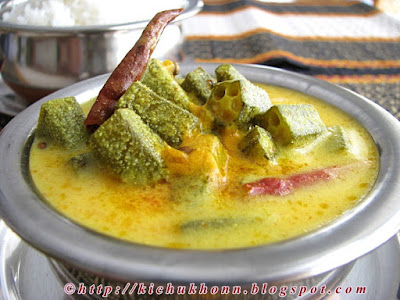
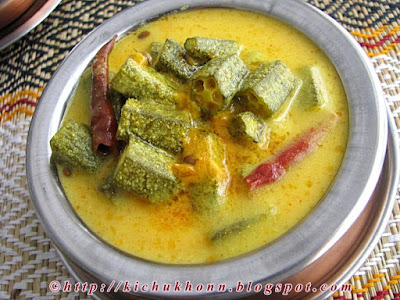
I had made this Bhindi ki kadhi for lunch one busy week day.
Quick to make, this one is a life saver. All you have to do is to make sure you have some rice to go with it.
I had left over rice in the fridge. Set this to cook and went about my rest of the chores.
I do not add any garlic to this, so it is different from my Lahsooni kadhi.
This kadhi has the temperings that I use when I make Kadhi pakoda ( I know I have to make a post on that one too).
I fry the Bhindi / Okra and make the kadhi together. You can fry and keep them aside and add later too.

Need :

Bhindi / Okra / Ladies finger - 250 gms, chopped
Whole Dhaniya / Coriander seeds - 1 tsp
Whole Red chillies (or you can use fresh green chillies too ) - 2, broken
Hing / Asafoetida - a pinch
Curd - 1 cup
Besan / Gram flour - 1 tbsp
Haldi /  Turmeric powder - 1 tsp
Red chilli powder - 1 tsp
Water - to make kadhi
Cooking oil - 1 tsp
Salt - to taste

How to :

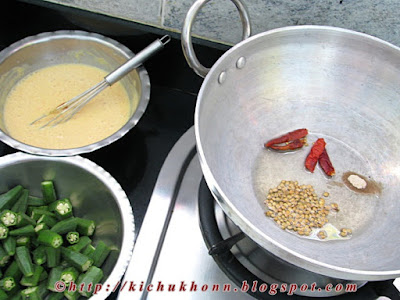
Mix the besan + curd + haldi + red chilli powder + salt + water.

Heat oil in a heavy kadahi.
Add hing, red chillies and whole dhaniya.
https://www.google.co.in/?gws_rd=ssl#q=bhindi+ki+kadhi+kichu+khon
Next add the chopped okra.
Add a pinch of salt. Cover and cook till the bhindi is done.
https://www.google.co.in/?gws_rd=ssl#q=bhindi+ki+kadhi+kichu+khon

Now remove cover and add the kadhi mix.
Add enough water.
Set it to boil on low flame.

Cook till you get the desired consistency.

https://www.google.co.in/?gws_rd=ssl#q=bhindi+ki+kadhi+kichu+khon
Serve hot with steaming hot rice.

Enjoy!!


Thursday, 31 December 2015

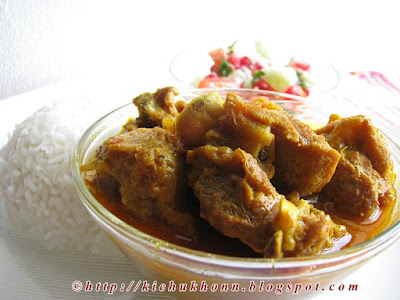
Mangshor patla jhol / A light, soupy mutton curry

https://www.google.co.in/?gws_rd=ssl#q=mangshor+patla+jhol+kichu+khon
To be honest, I had wanted this post to be a happy post. Some thoughts, some writings.
And lots of happy thoughts.
When I had cooked this light mutton curry, I had some friends staying over.
There was much banter and an easy air all over in the house.  Light food and close friends always make for a cosy, homely feel.
So I had thought I would write about all the fun we had and about all the food we took turns to cook.
But the months passed, not to mention the dark ones, and the photos languished in my folder.

In fact, when I started to post again, I kept skipping this recipe, waiting for better days that will echo in my post.
Which is why, right now, I have a recipe of the Chole tikki in my drafts.

But a few days back, I wrote on my Facebook page as to which recipe would my readers like to see in my next post.
And Monalisa wrote in to say " Light mangshor jhol sounds yummylicious!! Light golden jhol is apt for the gloomy lazy days of winter" 

https://www.google.co.in/?gws_rd=ssl#q=mangshor+patla+jhol+kichu+khon

 My friends have been a huge support the last few months.
Always with me when I needed them. A warm word here. A strong encouragement there.
Asking about my absence. Inquiring after my health.
So I will let the Chole tikki sleep in the drafts for a little while longer.
My friends will get what they want. So decided to make this post on the light mutton curry right away.

The sun has set on 2015 a few hours back.
Now comes the waiting part. Waiting for a new day. A whole new year.
New hopes. New fears.
New aspirations. New achievements.
2015 has taken much from me. I just hope 2016 will, if not give anything, not take anymore.

This jhol is light, runny and is light on spices.
It does have garam masala but in much less quantity than usual.
I have used chilli flakes, that I ground at home, for a little heat; you can skip that in case you want a plain jhol.

This is very different from the rich Mangshor jhol, that I make when I have guests.
Ma used to make this when she ran short of time.
Or in winters ... but that would have carrots, green peas, cabbage, etc.
I just added the much loved aloo or the potato ... a must in a mutton curry for Bengalis.

https://www.google.co.in/?gws_rd=ssl#q=mangshor+patla+jhol+kichu+khon
Need :

Mutton - ½ kilo, cleaned and washed
Potatoes - 2, halved
Onion - 1 medium, sliced
Curd - 1 teacup
Cooking oil - 1 tbsp ( I use mustard oil )
Salt - to taste
Sugar - a little
Black cardamom - 2. crushed
Black cardamom powder - just little pinch or maybe half a teaspoon (grind them fresh if possible)
Cinnamon - 1 small piece, crushed
Chilli flakes - 1 tbsp ( I dry roast red chillies and give them a short burst in the mixie )
Grated ginger - 1 tbsp
Garlic paste - 1 tsp
Turmeric powder - 1 tbsp
Water

How to :

Marinate the mutton with the curd + ginger + garlic + turmeric + chilli flakes.
I do not add salt in the marination.

Keep aside for at least half an hour.
Of course, you can keep it for a longer time or make it immediately if you are pressed for time ... but then, as everybody knows ... the longer the marination time, the better the flavours.

Heat oil in a pressure cooker.
Add the sliced onions and fry on low heat till well browned.

Add the crushed cardamom + cinnamon.
When you start to get the aroma, add the mutton and stir well for a while ... till everything is mixed properly. No need to fry for a very long time ... as in 'koshao'ing.

Raise heat, add the potatoes and enough water to make a gravy.
( I do not fry the potatoes first ).
Add salt and sugar.
Sprinkle the cardamom powder all over it.

Close lid and cook for 4 whistles on low heat.
The cooking time depends on the quality of the mutton ... so if needed you may cook for a few more whistles.

Remove from heat and cool.

Remove cover and check for the consistency of the gravy. If needed add water to make it thinner, but do check the salt accordingly.

https://www.google.co.in/?gws_rd=ssl#q=mangshor+patla+jhol+kichu+khon
Serve hot with rotis or rice.
 
Some chunky mutton pieces, some robust flavours in a spoonful of this light jhol, some winter sun, some chill in the air  ... all make for a great lunch ... holiday or otherwise.

Revel in health, love, sunshine and food, dear friends.
Wish you much happiness in the coming new year.


Friday, 24 July 2015

Ilish er Muri Ghonto / Hilsa head cooked with rice and spices

https://www.google.co.in/?gws_rd=ssl#q=ilish+muri+ghonto+kichu+khon

"There she goes again! She and her Ilish!"

I know, I know. I have a little too many Ilish recipes on my blog.
But then, I am sure you are not complaining. Or are you?
Come monsoons and I do buy at least one Hilsa fish to satiate my cravings for it. After all, I wait patiently the whole year through and never make do with the false ones, from the shores of Gujarat or Andhra, that make their way into the markets through out the year.
And my fishwala never disappoints me too.
"Aapke liye sirf Kalkatta Hilsa", he says.

And when I get that more than one kilo of divinely smelling fish home, I have to rustle up all the recipes I know with the Ilish.
The head, the tail, the petis, the gadas,  the roe ... all have different recipes to go into.
And I make full use of them.
Resulting in a happy me, with a zen like smile on my face, that you can get to see only on a cat after it leaves a kitchen that has just seen fish cooked.
And some good Ilish posts.
And a grumpy B, who has to suffer through these 2 months of monsoons when I get the Ilish home.

https://www.google.co.in/?gws_rd=ssl#q=ilish+muri+ghonto+kichu+khon
But this year, I haven't brought an Ilish home; not yet.
I had a couple of recipes lying around from last to last year and hence making some posts.
The last one and this. I don't think I have anymore.
And I don't think I will be cooking the Ilish this time.
Will go to my current favourite Assamese restaurant when I get the craving.

Of late, I have seen a number of people coming over here, browse through and then only too soon I see a post on their blogs.
Most of them think they are savvy enough to make changes to the recipe by adding a spoonful of an unnecessary ingredient just to make it look different. Like adding jeera to a recipe that has mustard seeds as tempering is so out and out foolish.
And sometimes a shoddy photograph along with one of mine.
I am assuming that they are new bloggers but at times there are older bloggers too.
All I say to them is dear ones, do be a little original.
I know these recipes are common but there can be a whole bunch of changes in them from family to family.
Like picking up my Thamma's recipe and saying it is your cook's recipe is just not done.

And as for plagiarism of ideas, I really have nothing to say.
Have long given up hope of seeing any light in these blokes' brains.

https://www.google.co.in/?gws_rd=ssl#q=ilish+muri+ghonto+kichu+khon
Coming to today's recipe,  I had made a light Ilish er jhol with cumin and ginger paste.
Remember?  If not, it is here.


So I had this masala left and wanted to use it with the Ilish head this time.
Did not want an ambol or tauk.
So decided on the muri ghonto.

I had never made muri ghonto with anything other than the Rui or the Katla head. So this was going to be new.  It does not have any onion or garlic and hence can be called a Niramish muri ghonto too. 

The fact that Ilish has a lot more and much finer bones in the head did not deter me at all.
My Dadu, Ma's father, was well known for his ability to chew and finish off all the bones of  the Ilish head. 
And as his grand daughter, the least I could do was to try it once.


 Need :

For the Jeera paste : -
Jeera / Cumin seeds - around 5 tbsp, soak for around 3 hours
Ginger - 1 and ½" piece
Whole red chillies - 4 (if you like spicy then use around 6 or 7)
Tomato - 2 medium sized

Other ingredients : -

Ilish head - 1 , cleaned and marinated with a little turmeric powder+salt
Tej pata / Bay leaves - 2
Rice - 1 cup, washed and soaked ( I used Basmati )
Cooking oil - 2 + 2 tbsp ( I use Mustard oil )
Ghee - 1 tbsp
Turmeric powder - 1 tsp
Whole red chillies - 2, broken
Lemon juice - 4 tbsp
Bhaja moshla - 1 tbsp
The jeera paste - 3 tbsp 
Salt - to taste
Water - 2 cups

How to : 
https://www.google.co.in/?gws_rd=ssl#q=ilish+muri+ghonto+kichu+khon

Heat 2 tbsp oil in a heavy kadahi / wok.
Lightly fry the fish head, break into pieces and keep aside.


In another kadahi / wok, heat 2 tbsp oil + ghee.

Add the bay leaves + whole red chillies + the jeera paste.

Stir well and keep frying till oil starts to leave the sides.

Add the rice and lightly fry.

Raise heat, add the fish head pieces + turmeric powder + lemon juice + salt + water.

Cover and cook till rice is just done.

https://www.google.co.in/?gws_rd=ssl#q=ilish+muri+ghonto+kichu+khon

Remove cover, sprinkle the bhaja moshla all over, give a light toss and cover.

Switch off heat after 5 minutes and let it stand for another 5 minutes.

Done!
https://www.google.co.in/?gws_rd=ssl#q=ilish+muri+ghonto+kichu+khon

I like to keep the rice grains fluffy and separated though traditionally the muri ghonto is slightly sticky.
You can add chopped potatoes to it too.

I love it just as it is.
As a whole meal, if I do not have guests.

Rustle up a salad or a raita and you are good to go.
Enjoy!!


Here is a list of my Ilish / Hilsa recipes to enjoy in this monsoon. 


Monday, 29 June 2015

Badi Santula / Vegetables cooked with dried lentil dumplings

badi santula odiya
I just can't have enough of the rains.
Ever.
Last week it had rained non stop for three to four days. With dark clouds, heavy wind and fog.
Pune's rains are like quiet children.
They will be around yet you won't feel their presence. Calm, quiet, a little shy and not at all noisy or rude.
So unless you are in the vicinity of a window or the outdoors, most of the time you won't even know it is raining. And in the earnest, too.
So every time I knew it was raining, I would drop everything and rush to the windows.
We have huge bay windows and even the slightest opening is enough to drive the heavy  wind inside, resulting in papers, pens, glasses and other things flying off the dining table and whirling around in the rest of the house.
And god help me if there is a newspaper around.
Still, nothing could stop me from opening the window ... even a wee little bit ... and smell the wet air deep. The smell of rain and fresh, wet leaves and the earth and grass ... everything reaches deep into me and my soul.
Such freshness!
Such peace!

Now we are back to cheerful, sunny days, though there are clouds hovering in the horizon.
Very soon, they will come over. And stay for a while.
And I can spend more time near my windows. Yes, I have even moved a sofa to be real near.
To be able to feel the spray on my face .
And let the cold wind take my breath away.
My poncho is almost done. Hopefully I will be able to snuggle into it too.
And my favourite writer's latest book is at hand. I am saving it for the rains.
Yes, I can be patient.

odiya vegetables santula

I don't know about the rest of the country, but rains in Pune means cold weather.
And with the temperature almost nearing 17 degrees, to me it is very, very cold weather.
Which reads, along with the Bengali favourite Khichudi, blankets, shawls and sometimes the heater too.
And Pithe.
Or Pithas. The Odiya pithas. Mostly the savoury ones.
And some garam garam, light, soupy Santula to go with them. 

Growing up in Orissa / Odisha meant being familiar to Odiya food as much as I am familiar to Bengali food. And the Oriya lady who stayed with us and did the cooking most of the time played a big role in this.
Most Oriya pithas , especially the savoury ones, are accompanied with a light vegetable curry like the Dalma or this santula.
While the dalma is made with dal/lentils and vegetables, the Santula has just vegetables in it. And sometimes the badis or sun dried lentil dumplings are added to it too.

The most common pithas that have the Santula as an accompaniment is the Chakuli pitha, the Santula pitha, the savoury Podo pitha and a few others too.
However, this light, comforting curry is eaten with rotis or rice too. 

All you will need is a few vegetables.
No masalas. Yet delightfully flavourful.

santula


Need :

Vegetables - cut into cubes , around 1 small bowlful
( I had raw, papaya, raw bananas, parwal / pointed gourd, brinjals, potatoes. You can use pumpkins, sweet potatoes ... any vegetables of your choice )

halka sobjir jhol
Badis / Vadis / Boris - a small handful
Garlic - a few cloves. smashed
Jeera / Cumin seeds - 1 tsp
Turmeric / Haldi powder - just a pinch 
Onion - 1 medium, chopped
Whole red chillies - 2, broken
Cooking oil - 2 tbsp ( I use mustard oil )
Salt - to taste
Water - 4 cups or more if needed

How to :

Fry the badis and keep aside.

Heat 1 tbsp oil in a heavy kadahi / wok till it is smoking hot.
Lower heat and add jeera, the red chillies, onions and the garlic.
Fry for a while.

Now raise heat and add the vegetables.
Stir fry for a while on high heat.

Add salt and the haldi powder. Fry well.
oriya santula

Add enough water to submerge the vegetables, cover and cook till they are well done.

Remove cover, check for water.
Add some more and add the badis (they will soak up water).

Cover and cook for 5 more minutes ( more if using bigger sized badis).

Remove cover and check.
The vegetables will by now have mixed together well and the badis must have soaked up the gravy well.

Remove from heat , add a dollop of ghee (if you want to ) and cover and let it stand for 5 minutes.


vadi santula

Serve fresh and steaming hot.

I was tempted to sprinkle some roasted jeera powder on top, but resisted myself.
And I'm glad I did.
Because the flavours of the vegetables and the slight hint of garlic and the badis had mixed together and was divinely wonderful!

bori santula
We had it with rotis for lunch.

Try this one of these days.
After a day long's work, enjoy this comforting, light jhol with some soft, hot rotis for dinner.
With the rain keeping you company from the outside.

And don't forget to let me know how you like it.

Enjoy!!


Tuesday, 7 April 2015

Mirchi ka Achar / Green chilli pickle - 2


Mirchi ka achar

In every moment, hour or day, in our life, there is a lesson hidden. Every person, every animal, every change in nature teaches you something. You are vigilant enough, quiet enough inside .... you get to learn.
Like I am doing these days.
I am learning what 'class' is ... all over again.

Life has doled out to me my share of bullies ... and more. And to tell the truth, I have never been one to handle them well. I'd rather stay back and let them do all they can to get attention. I had learnt early that bullies want attention. To feel important. To feel they are in control.
Starting in school, where I had to face this bully of a girl who had slid down two classes and landed with us and her little sister, who was my friend.
Her idea of superiority lay in scaring us, just before exams, with numerous ideas of what could go wrong and how we could either have to hand over a blank paper or write every answer wrong and end up with a zero.
Cruel.
My getting good marks was not enough to instill even a little courage, or wipe away the fear this caused, in me.
It has stayed on as a terrifying memory always.

Later in life, there have been other bullies too.
But what I had noticed most was their pattern and motive was always the same.
To create fear. To subdue. To feel superior. To grab attention.

Ma had always tried to drill it into me, "Never give in to insolent might" ... quoting a line from one of Rabindranath Tagore's poetries, that we often sang at our school assembly along with other hymns.
"And always remember your class. "

I often wondered how difficult it must have been for Ma, a spunky and educated lady, belonging to a prominent family, brought up in a city like Delhi and later married into an equally prominent but very traditional family, to bring up a quiet, shy, sensitive and introvert daughter like me.
She did make sure that I took part in everything ... and excelled too. School dramas, debates, singing competitions, good marks ... every possible thing.
And I loved them too.
However, while this made me every teacher's pet, it made matters worse when it came to the bullies.
Thankfully, my growing up in a joint family hugely helped in not turning me into an unsocial person.

Mirchi ka achar
When I left home to come to this city for further studies, things started to change.
My friends here brought me out of my shell. Family instilled values and Ma's constant encouraging voice was already inside me. Coupled with my friends encouragement, I started to open up.
Learnt to express my thought and feelings ... to a certain extent albeit.
Bullies were around in college life too ... but they very few. And very subtle.
My achievements would draw a couple of cold shoulders ... that is all.
But with wonderful friends, they were happily ignored.

Ignore.
That is when I started to learn how to deal with the bullies.
Ignore them.
They wanted the attention they could not get by their usual activities ... which were hardly of any worth, not surprisingly. Hence the aggression.
Slowly, I learnt. Later in life, there have been different kinds of bullies in every turn.
Some love to hurt with words. Some love to show aggression.
But they were all the same. To me.

And I learnt to ignore. To keep my head high. To stay quiet and move to the back of the crowd.
To not stoop and retaliate.
To remember what 'class' is. 
And to do the best in whatever I am doing.
That, eventually, would shut them up.

It is difficult to develope a thick skin, but in the end you learn to dust the hurt off your shoulders with, if not a flick, a good two or three hard pats, and resume on with life.
There would be tears for a while, but as I grew older I realised not everyone had the patience to deal with them.
Life is a teacher. And a good teacher too.
And last night, something happened to remind me of bullies .... that eventually led to this writeup.

Green chilli pickle
On the streets just outside our housing complex, roams an abandoned dog, since last monsoon, when he was still a growing puppy. He is healthy, his black coat has a shine and walks with a grace unseen in other strays.
Clearly, he belongs to a good breed.

Our watchmen and other people of the society adopted him when food was concerned. He sleeps under the watchmen's table. But he needs company.
Bouncing with energy, he approaches anyone nearby to play with him.
While the humans often respond with love and attention, the street mongrels are not so friendly.
In fact, they refuse to allow him to be anywhere near them.
We watch with hope that he would be able to mingle with them eventually and learn the ways of surviving on the streets.

Last night, I watched as he tried to approach and befriend a group of street dogs, who reside in this area, again. Futilely.
The dogs started to growl and bark at him. Some, who were on the opposite side of the road, rushed in too.
And jumped on him, all the while barking furiously.
But all he did was keep stepping back. Neither once did he growl back, bark or show any kind of aggression. Which is surprising for a fully grown dog.
But no. Not once did he retaliate.
I have seen this happening a lot of times, and as always, he quietly stepped back and slowly walked away. Head high, nary a sign of defeat in his stance.
The rest of the mongrels kept barking at him till he turned around the corner and disappeared.

And all that came to my mind was " That is 'class'."

Cooking green chilli pickle
A few days back I got these very fresh Kashmiri green chillies and wanted to make something new with them.  Did not feel like cooking them the usual way and see them wilt.
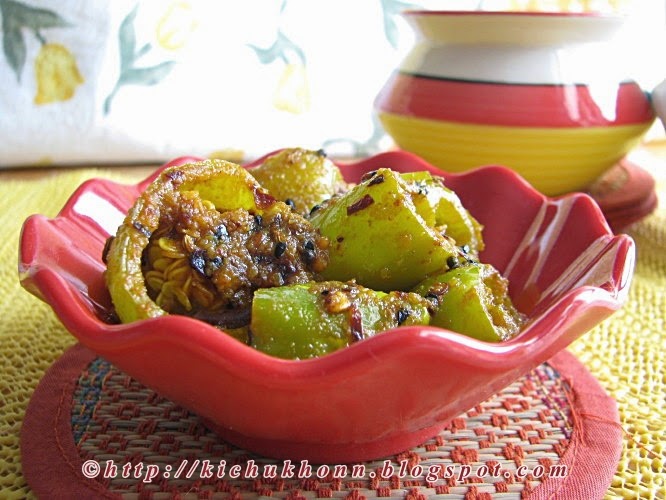
So chopped them up and made this quick Mirchi ka achar or pickle.
The fresh crunchiness stayed. And mixed with the pickle masala and vinegar, tasted beautiful.
I did not have hing/asafoetida at home ... so this is a no hing achar.

Need :

Fresh, green Kashmiri chillies - 6 pieces, chopped into big pieces
Paanch Phoron - 1 tsp ( Saunf+Sarson+Kalonji+Methi+Jeera)
White/Yellow mustard powder - 2 tbsp (I just gave a pulse in the grinder)
Red chilli powder - 1 tbsp
Salt - 1 tsp
Vinegar - 2 tbsp (I had chilli vinegar)
Mustard oil - 6 tbsp

How to:

Heat the mustard oil in a kadahi, till it smokes.
Remove from heat and cool slightly ... so that the Paanch phoron does not burn.

Add the Paanch phoron and return to heat.
When it starts to splutter, add the chopped chillies and toss well.
Add salt + red chilli powder.
Fry well, till the chillies are a little cooked. Do not cover.

Add the mustard powder and the vinegar and toss well on high heat.

Lower heat and give a good stir and remove.

Mirchi ka achar
Cool before serving.

This stays well in the fridge,covered, for a week.
You can add half a teaspoon of sugar too ... if you want it slightly sweetish.

Goes great with a meal of hot rotis and sabzis.
 Or on the side of a rice meal too.
I often dunk in the masala and a little oil in a simple dal ... takes the dal to a different level.

Here is a snap of my lunch plate with his pickle ... Rice, Bhaja mooger dal, Aloo Borboti fry, Salad and Mirchi ka achar.
Bengali vegetarian lunch plate


Enjoy folks !!

My other Mirchi ka Achar, made with small green chillies is here 
... with an equally long, but hilarious, write.
Coincidence!!


Saturday, 1 March 2014

Mirchi Ka Achar / Pickled Green Chillies

https://www.google.co.in/#q=mirchi+ka+achar+kichu+khon

 I have been noticing in the last few months that the post on Kuler achar / Ber ka achar has been getting the most hits. People from Indonesia to Japan to the UK  to our good ole Kolkata, even Chattisgarh, have landed on the page searching for "how to make kuler achar". I have no idea if the recipe has helped anybody at all ... nobody bothers to leave a line these days ... but that is understandable.
I must confess that I have never been a fan of achar/pickles. And that one post was done one an impulsive,  self congratulatory mode ... the intention more of a record of my achievement than to actually help anybody with the directions of making achar.

As a child, I remember the uthon/courtyard  filled with different kinds of jars and earthen wares filled with numerous kinds of achars, all made by Thamma. I was never interested in them, tart and spicy things that made your mouth burn and made you gulp down glasses of water to return to normalcy.
And since they did not interest me much, the fragrance of those mysterious looking pots would be enough to make me turn back into the house if I ever ventured towards the uthon in the afternoons.

It was a different story altogether for the rest of the brood ... read cousins.
When the huge house went quiet in the afternoons, and Thamma and the rest of the Kakimas had retired to their respective rooms, and the helps would doze off in different corners of the house, the children would quietly get up and tip toe out ... but only after making sure their mothers were in deep sleep.
Very quietly, they would open the door to the dining room and then the one that led out to the uthon .... hushing each other, stiffling giggles and making sure that the squeaks from the door hinges made very,very little noise.
And then, they would raid the achar pots.
Run the mustard and nigella seeds in the mixer
The bhaarar ghor / store room and the kitchen stood adjacent to each other, on the long verandah above the uthon. The whole room smelled of different kind of spices and oils and achars. Numerous things were stored there. Among them were two huge tables that were joined together just to keep the jars of achars. The room was dark and cool. And a good hiding place too.

Didi was the gang leader and gave all the directions. The cousins would break up into pairs and each pair was alloted a day.  One would keep watch while the other raided the bharar ghor, pick up fistfuls of achar from which ever pot was nearest at hand and quietly make an escape. This scheme worked well with all the pairs except for the youngest lot ... the pair of  S and L.
And it was this pair that brought the downfall of the brilliant plan of achar chori.

It was just another weekday and the family had retired for the post lunch siesta. It was a hot, summer afternoon  and there was a quiet all over. S and L went quietly downstairs to do their job, with strict instructions from Didi.
L was younger, so was given the job of the lookout. She was to call out "Meeow", if she happened to see anybody approaching. And by anybody ... all they had expected was one or two house helps.

After S entered the store room  and was going about picking fistfuls of achars, she heard footsteps  outside.
Quickly she ducked under the huge table and went very quiet. Someone came up to the door and stopped. And she heard a muttering ... "The helps are no good ... have left the bhaarar ghor open. What if a cat comes in?"
Jethu!!
Our eldest uncle had not gone to office that day! But as usual, we children were oblivious of  everything. So ... with some more mutterings, Jethu reached out and shut the huge doors of the store room and walked away.
Mix the chillies + masala + salt
S sat trembling under the table, inside the huge, dark room. Filled with numerous things of all shapes and sizes, it was a terrifying place to be all alone. And that too with the burden of guilt.
L, who had scampered away the moment she had heard Jethu, was meanwhile explaining to a furious Didi , who kept on repeating that all she had to do was to meeeeooow! , just how life threatening it was for her to stand by S.The house helps, she could have managed; but Jethu was a different case altogether.

Now came the point of how to rescue S. The store room was not opened in the evenings at all ... unless it was to get rice or coconuts out.
Hence trying to convince the elders to open it was a huge task.
So they decided to convince Thamma to open it.
"But why?"
"Because there is cat inside."
"A cat?! In my bharar ghor?!"
"Yes, Thamma, a big cat. What if it destroys your achar pots?"
"Tobey re ... awww Suro, aan toh jhaata ta!!"


Add some vinegar
The very thought of swiping poor S with the broom was even more distressing to the already upset gang.
But no ... that is the only way Thamma would open the room.
So ... armed with the biggest coconut stick broom, Suro, our house help, stood guard while our four feet high Thamma reached up to open the store room, signalling Suro, to give a big thwack as soon as the cat runs out.

As soon as the door opened, the cousins started to scream of "Don't run, don't run!" ... meaning to save S from a tremendous thwack. But on hearing the screams, Thamma jumps back, the door swings open and Suro keeps on beating the ground with the broom ... thwack, thwack, thwack.
And poor S ... in all the commotion, jumps up and scoots out, banging head on into Thamma.
"Orey chor, chor,chor!!!" ... Thamma screams.

Jethu, who, along with the rest of the family, had reached the uthon, to see what all the noise was about, reaches out and grabs S in one hand and holds her up to see the chor.
Seeing S dangling from Jethu's arm, the cousins break up and scramble away in all directions. 
And Thamma keeps on screaming "Chor,chor,chor!" and Suro, in his attempt to get the cat out,  kept on banging the broom ... thwack!, thwack!, thwack!, ...

Pour in the mustard oil
I don't remember any more achar chori stints after this episode.
But the story has stayed on to bring out the loudest laughter at every family gathering henceforth.


I made this Mirchi ka achar a few months back. A call out on FB and Soma, Sayantani ,and Anjali gave me the links to their versions. I took all their versions and made mine.
 
It is way too easy. Just ensure that you have the spiciest of the chillies ... they lend a beautiful fragrance to the achar.


Set in the sun for a week

Need :

Green chillies - cut into small pieces
Mustard oil - enough to drown the whole lot of chilles
Mustard seeds
Kalonji / Nigella seeds
Hing / Asaefotida
Salt
Vinegar

How to:

Run the mustard seeds and the nigella seends in a mixer ... just a couple of spurts ... and make a coarse powder.
Mix the chillies with this powder, salt and vinegar.
Heat the mustard oil ... the quantity depends on the consistency you want ... I wanted more of the fragrant oil so used a lot.
When it reaches smoking point, remove from heat and add the hing.
Cool.
Pour into the chilli mix.
Let it stand in the sun for around a week.

Done!!

I enjoyed the oil on hot steamed rice. And the achar goes great with any kind of parathas.
Enjoy!!


Some other Achars / Pickles that I have, successfully, tried my hands on  : - 

Aam Ka Achar  

Ber Ka Achar / Kuler Achar

Tel Kopi / Pickled Cauliflower  

Kanji Vada ( not exactly a pickle, but equally tangy and tasty )


Friday, 20 December 2013

Kanji Vada

 https://www.google.co.in/#q=kanji+vada+kichu+khon
 The first time I had Kanji vada was in Jaipur, on a cold winter afternoon in the middle of a Diwali week.
They are sold on hand carts ... big sized mud pots filled with the fermented, tart water and big sized and very soft lentil dumplings or vadas in it.
I did not like the taste ... found the taste close to something rotten ... and promptly rejected it.
The Rajasthani man was not amused and insisted that the properly made ones are really tasty.

And so on the next Holi, I was introduced properly to the perfect, home made Kanji ... this time made by sis-in-law at her home.
I'm not too fond of sour things ... but liked the taste this time.
It was fermented just right and had that light tartness .. not too sour , not too salty.
The vadas were fresh and perfectly soft ... not falling into pieces like they have reached a state of  'too much of fermentation'.
I loved it this time.

In the intial years of my marraige I never made this. But later I started to make it once every year.
But not in winter. I used to make it in October. The intensity of the sun was just right to ferment the water in just a couple of days.
This time however I made this in December and it came out perfect. 

https://www.google.co.in/#q=kanji+vada+kichu+khon
My Rajasthani in-laws do not add anything to the kanji other than just the vadas.
Sis-in-law uses the black carrots that she gets abundantly in Delhi during winter. I used some plain carrots.
I used Urad dal and also added some fresh chillies and sliced ginger for some taste.
With the intense sun on my balcony, it took just 4 days for the Kanji to ferment.
I sunned it under direct sunlight on the balcony for 4 days and then kept it in the light sunlight on my dining table for the next 5 days that it lasted for.

On my dining table these days .... 
Need :

Ample sunlight
Urad dal - 1 cup, washed and soaked overnight
Carrots - sliced into thin pieces
Ginger - sliced into thin pieces
Fresh chillies
Mustard powder - 3 tbsp
Black salt - 2 tsp
Red chilli powder - 1 tsp
Water - around 8 coffee cups
Oil - to deep fry

How to :

Make a paste of the soaked dal with some salt.
Heat enough oil and  deep fry small balls of the dal paste.
Take a clean bottle ... I have given the full picture of the bottle I have used to give an idea.
Pour in the water and rest of the ingredients.
Add the vadas too.
Close lid.

https://www.google.co.in/#q=kanji+vada+kichu+khon

Sun it for 3-4 days in direct sunlight, with the lid slightly open.
Do remember to bring it inside before evening sets in.
After that it is ready to consume ... but do check for the level of tartness.
If you feel like, you can sun it for a couple more days too ... depending on the intensity of the sunlight that you get in your part of the world. 

https://www.google.co.in/#q=kanji+vada+kichu+khon
Serve cool. 
The carrots and the ginger soak up the flavours and taste great!
Enjoy!!

Sunday, 3 March 2013

Aam ki chutney / Mango chutney

 
It has been one of those days when everything goes right.
Everything goes smoothly ... all errands done, all chores finished, every pending bill paid, 
every encounter positive.
Yes, the latter matters most to me.
After a spate of never ending dark days ... some days it seemed I would never ever be able to get up
 and face the world again 
... some days I had felt I would never be able to see the light of the next day,
a little goodwill and a little cheer handed to me
helps me move ahead.
Helps me realise how precious those few people are ... who stood by me ... from near and afar ...
giving me strength, love and the power to believe
that a better day will come. 
Again.
Which is why every smile that comes my way matters to me.
Every good word said to me takes me to newer heights of happiness.
Every good deed done to me reaffirms my faith in humanity.
Make me want to believe that every person is not like the ones who have come into our lives being friends, and left us all alone;
cheated, defeated and making a joke out of our trust in them.

 I was not like this. Not always. Not ever.
I flew through life ... with achievements and love. Doing good deeds.
Feeling secure. 
But time brings about tests.
Untold surprises. 
Testing our faith, our resilience. Our ability to still  have trust on the higher power.
And those who move ahead, survive.
Which is why today I appreciate every good in life even more than ever.
Because I know ... there is very little good left in the world.
And if a little of that has come your way, you are blessed.
I am blessed. I realise that.
And I know ... life will be a heady mix of the sweet, the bitter, the spice and the tang.
Love it ... and it will love you back.

Which is why, when the salesman at the store today, made a small gesture of
putting us in a different section of the store where only
special billings are done,
saving us the tedious waiting at the long, long billing counters,
I thanked him
and added a  "God bless you." spontaneously.
The smile on his face showed he was touched too.
Yes, I believe in the higher power.
He will give back what he has taken.
He will return every deed done ... to Him and to us.

Spicy, tangy, flavourful life.
 Just like this mango chutney my Ma in law makes. 
Simple, tangy and spicy. 
You'll love the flavours. And since it does not have a lot of masala, you will get that strong flavour of raw mango ... which I'm sure, all of us love.
Just that very fragrance tells us summer is here!

And this is very different from the Bengali Aamer chaatni.

Need

Raw mango - cut into thin slices ( I tried grated, but they turn into mush quick)
Whole jeera/cumin seeds
Salt
Hing / asafoetida
Haldi powder / turmeric
Sugar (can be done with jaggery too)
A little oil
Red chilli powder

How  to :

Heat oil. Add the jeera and hing.
Add the mango slices and stir fry on high heat.
Add the haldi powder, salt and sugar.
Cover and cook till the mangoes are done but not mushed up.
Add the red chilli powder and give one more stir.
Remove from heat and cool.


Serve cool, on the side.
Goes great with parathas or pulao.
Enoy!!


Friday, 27 February 2009

Tel Kopi / Cauliflower preserved in Mustard Oil

The pleasure of food blogging is getting to know about different kinds of recipes being prepared all over the world. And this pleasure is magnified when we come across recipes that have been in a family for years ... passed on from generation to worthy generation. What make these recipes very special is the love, warmth and nostalgia that is associated with them.

I recently came across one such recipe in a fellow blogger's blog. She goes by the name L .
And this recipe .... Kopi'r Teyl ..... literally translated means Cauliflower's Oil .... is her Jethima's ( aunt's ) ... and told to her by her mother.


I was pretty intrigued by this recipe. And the fact that she did not have a snap of it made me a little unsure too ... as I could not know how the finished product would look. But I decided to give it a try .... for the simple reason that it needs so few ingredients .... and is so very easy to make.

You have to really love mustard oil to like this. I must admit I was in half a mind to add something extra to it ... i.e. a little achar masala at least. But hubby dissuaded me from that. His take was ... I would never know the original taste/flavour if I did that. Point. :-)

Here's the recipe.


Need
1 big sized Cauliflower
Enough Mustard Oil to cover the florets
Turmeric Powder
Red Chilli Powder
Salt
Water ( to boil the florets in)

How to :

Take a Cauliflower and break off the florets.

Boil water with a pinch of salt and add the florets.
Cook the florets in it for a couple of minutes and remove.
Be very careful not to overcook them ... they will hold moisture and your achar will spoil quickly.

Pat them dry with a napkin or tissue.
Air them for a while.

Now place the florets in a bowl ... preferably glass.

Add turmeric powder, red chilli powder, salt and mix well.

Cover the bowl with a cloth and sun dry them for a day.

( I tried the other way too ... dried them first and then added the salt + chilli ... worked too. )

Take a dry, sterlised bottle and put in the dry florets.
Add enough mustard oil to cover all the florets.

Let the bottle sit in the sun for 2 more days.
It is ready to be served now ... but I still kept it in the sun for a few more days.

If the level of oil decreases with use, add some more oil.
Take care that the level of the oil is always above the florets to prevent fungus.


Enjoy!!

She says to have it with rotis .... which we did. But let me tell you ... it was fabulous with plain hot rice too.

Thanks L for sharing this wonderful and unique recipe. :-)


Am so glad I tried it.